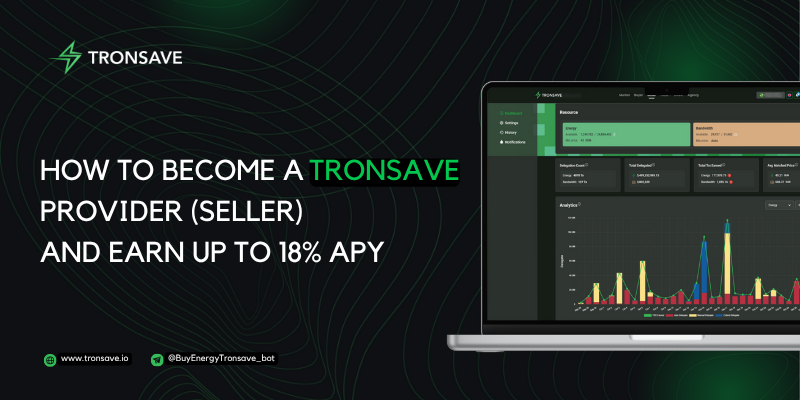
To become a Tronsave provider, you stake at least 5,000 TRX on TRON to generate Energy, grant Tronsave a limited resource-delegation permission, then sell that Energy through Manual, Auto Sell, or Sell Suggestions. Returns are variable and not guaranteed — historically up to roughly 18% APY, depending on market demand.
Key takeaways
- What it is: A Tronsave provider stakes TRX for Energy and rents it to traders who need it for cheaper USDT (TRC-20) transfers.
- Minimum: You typically need at least 5,000 TRX staked to register as a seller.
- Returns: Yield is variable. The “up to ~18% APY” figure is a historical high, not a promise — actual returns track Energy demand (as of 2026; verify against the live market).
- Liquidity: Staked TRX is subject to TRON’s 14-day unstaking period, so funds are illiquid during that window.
- Permission safety: Tronsave receives only a Resource Delegate permission. It cannot move, transfer, or withdraw your principal TRX, and you can revoke it on TronScan at any time.
- Alternatives: You can also earn yield by staking TRX directly for the native Stake 2.0 reward, or list Energy on other rental marketplaces.
What does it mean to become a Tronsave provider?

On TRON, every USDT (TRC-20) transfer consumes Energy. Users who lack Energy either burn TRX as a fee or rent Energy from a marketplace at a fraction of that cost. A Tronsave provider sits on the supply side of that market: you stake TRX to mint Energy, then rent it out to buyers and collect the rental income.
This is fundamentally a resource-rental business, not a deposit account. Your earnings come from real demand for Energy, which rises and falls with on-chain stablecoin activity. When transfer volume is high, Energy rents for more; when it is quiet, yields compress. That is why no honest guide can promise a fixed rate.
Why do buyers rent Energy at all?
- Renting Energy is usually far cheaper than letting the network burn TRX for the same transfer.
- Buyers avoid locking up their own capital in staking.
- It keeps wallets topped up for high-frequency USDT payouts. For background, see our guide on why renting TRON Energy reduces USDT fees.
How much can a Tronsave provider earn (and what drives the APY)?
Headline numbers like “up to 18% APY” describe a best-case historical window, not a guaranteed rate. Your real return depends on a few moving parts:
- Energy demand: More USDT transfers on TRON means more buyers competing for your Energy.
- Your pricing: Lower margins fill orders faster; higher margins earn more per order but sit longer.
- Utilization: Idle, unsold Energy earns nothing, so fill rate matters as much as price.
- Base staking reward: TRON’s native Stake 2.0 also pays a smaller voting/reward yield on staked TRX.
| Factor | Effect on your yield | You control it? |
|---|---|---|
| Market Energy demand | Primary driver — high demand lifts rental rates | No |
| Profit margin you set | Higher margin = more per order, slower fills | Yes |
| Fill / utilization rate | Unsold Energy earns nothing | Partly |
| Selling method | Auto Sell improves utilization vs. manual | Yes |
For a deeper look at base rates, compare with TRON staking APY and how to maximize TRX rewards, and with the passive-income approach in lending TRX Energy for passive income. Treat any specific APY as variable and figures as of 2026; verify against the live market before committing capital.
How do you stake TRX to get Energy?
Becoming a Tronsave provider starts with Stake 2.0, TRON’s resource-staking model. In the Seller tab, choose “Stake more,” select Energy as the resource, enter your staking amount, and confirm.
The amount of Energy you receive is proportional to your share of all TRX staked for Energy network-wide. TRON expresses this roughly as:
Energy obtained = (your TRX staked for Energy / total TRX staked for Energy on TRON) × the network’s total Energy supply.
Because the denominator and total supply move over time, your exact Energy fluctuates. For the authoritative formula and mechanics, consult the official TRON Stake 2.0 resource model documentation. Remember: staked TRX takes a 14-day period to unstake, so plan around that lockup. If you are unsure which resource you are minting, read does staking TRX provide Energy or Bandwidth.
What permission does Tronsave actually get — and is it safe?
This is the step that deserves the most scrutiny, and it is good practice to question it. To let Tronsave delegate Energy on your behalf, you add an Active Permission on your TRON account that grants only the Resource Delegate right to Tronsave’s operator address (TXUwRhntqX3kyALhtpC74JP8Nt6m2VMiYC).
- What it can do: delegate (rent out) the Energy your staked TRX produces.
- What it cannot do: it does not include the TransferContract / balance permission, so it cannot move, send, or withdraw your principal TRX. Your owner key stays in your control.
- How to verify: open your account permissions on TronScan and confirm the active permission lists only the resource-delegate operation.
- How to revoke: in the same TronScan permission editor, remove the Tronsave active permission and sign the update with your owner key. Access ends immediately.
Never grant an “owner” or balance permission to any third party. Granting only resource delegation is the standard, lower-risk way to run a rental pool.
For the wider picture — what buyers, providers and API users each expose, and the settings worth checking on a shared address — see is TronSave safe: custody, permissions and what you actually expose.
How do you sell Energy as a Tronsave provider?
Once staked and permissioned, you can list Energy three ways. Most providers start manual to learn the market, then switch to Auto Sell for hands-off utilization.
| Method | How it works | Best for |
|---|---|---|
| Manual Sell | You match open buy orders yourself and set each delegation | Learning the market, full control |
| Auto Sell | System auto-matches orders that meet your rules (margin, max duration, min amount) | Hands-off, high utilization |
| Sell Suggestions | Telegram alerts when a buy order matches your filters | Catching spikes without watching screens |
- Manual Sell: connect your wallet, review the buy order, click Sell, and enter the delegate amount. A MultiSign option lets a co-signer delegate on your behalf.
- Auto Sell: set your target profit %, max delegate duration (default 30 days), minimum delegate amount, and an amount of Energy to keep undelegated. You can also enable automatic reclaim and reward withdrawal. Our guide to TronSave Sell Settings walks through every field, including how the earning share trades off against order priority.
- Sell Suggestions: link a Telegram ID, verify it, and apply filters so you are only alerted on orders worth acting on.
New to the Energy market overall? Our overview of how to get TRON Energy fast and save on fees explains the buyer side, which helps you price as a seller.
Is being a Tronsave provider right for you?
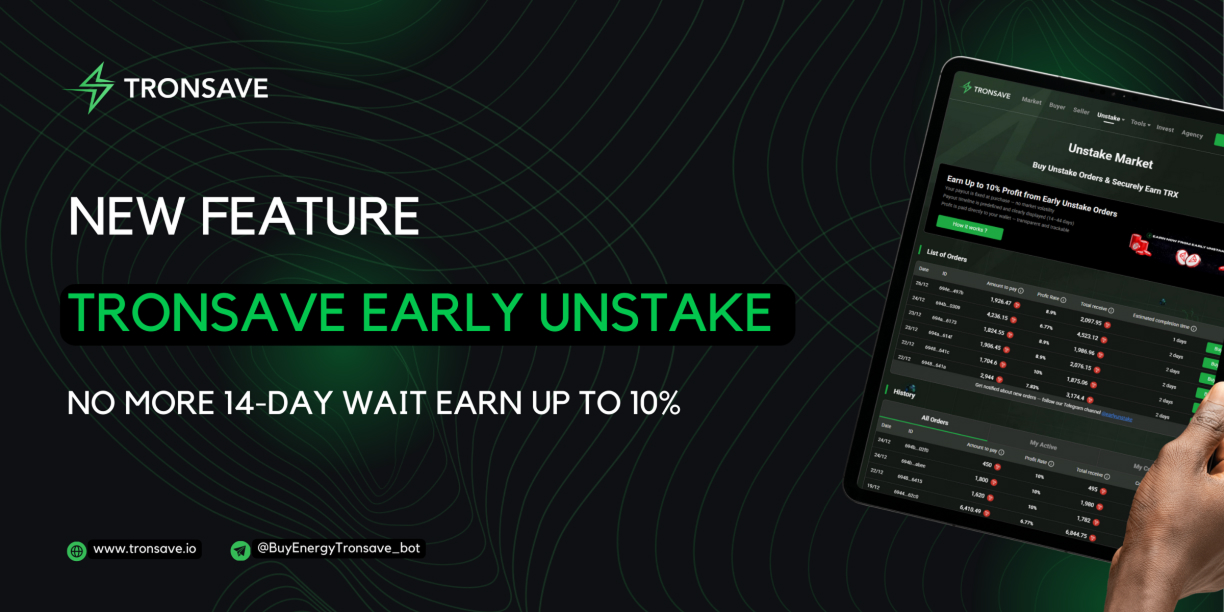
It suits holders who already own a meaningful amount of TRX, are comfortable with a 14-day lockup, and want yield beyond the base staking reward. It is less suitable if you need instant liquidity or want guaranteed returns — neither exists here. As always, weigh Tronsave against simply staking TRX natively or using other Energy marketplaces, and size your position accordingly.
If you have an audience but not the capital, the other side of the coin is the TronSave referral program: it pays 5% of every order the people you invite place, with nothing staked and nothing locked up.
Frequently asked questions
How much TRX do I need to become a Tronsave provider?
You typically need at least 5,000 TRX staked for Energy to register as a seller. Larger stakes produce more Energy to rent but also lock up more capital under the 14-day unstake rule.
Is the “up to 18% APY” guaranteed?
No. It is a historical best-case figure, not a promise. Real yield is variable and driven by Energy demand, your pricing, and utilization. Treat all figures as of 2026 and verify against the live market.
Can Tronsave take my staked TRX?
No. The permission you grant is limited to Resource Delegate. It does not allow Tronsave to transfer or withdraw your principal. You keep your owner key and can revoke access on TronScan anytime.
How do I revoke Tronsave’s permission?
Open your account on TronScan, edit your active permissions, remove the Tronsave entry, and sign with your owner key. The delegation right ends as soon as the transaction confirms.
How long until I can unstake my TRX?
TRON’s Stake 2.0 enforces a 14-day unstaking period. During that window your TRX is illiquid, so only stake funds you will not need immediately.
Are there alternatives to becoming a provider?
Yes. You can stake TRX natively for the base reward, lend Energy through other approaches, or use competing Energy marketplaces. Compare yields and lockups before deciding which fits your goals.
⚠️ Not financial advice. This article is for educational and informational purposes only and reflects the author’s opinion at the time of writing. It is not investment, financial, legal, or tax advice. Cryptocurrency is highly volatile and you can lose your entire principal; prices, APYs, and on-chain fees change constantly and may be out of date. Always do your own research (DYOR) and consult a licensed financial advisor before buying, selling, staking, or lending any digital asset.
Disclosure: This is the official TronSave blog. TronSave sells TRON energy/resource (fee-reduction) services and has a commercial interest in the products and topics covered here.
Another way to earn: run a TronSave Agency Bot and collect commission on energy sales — no staking required.