What is TRON staking APY?
TRON staking APY is the annual return you earn by staking (freezing) TRX and voting for Super Representatives on the TRON network. As of 2026, plain voting rewards typically land in the roughly 3%–7% range depending on which Super Representative you vote for and their commission. But that headline number is only half the story: staked TRX also generates energy, and selling that energy on a marketplace can lift total yield to up to ~18% APY through TronSave Earn. Returns vary with market demand and are never guaranteed.
This guide covers how Stake 2.0 rewards actually work, what realistic APY to expect in 2026, and the step-by-step for both plain staking and the higher-yield energy-provider route.
Key takeaways
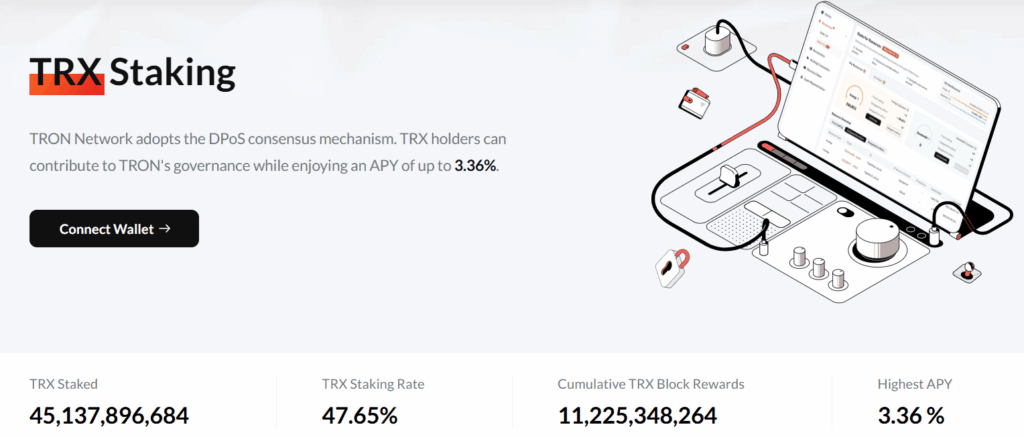
- Typical voting-reward APY is roughly 3%–7% as of 2026; the exact figure depends on your Super Representative’s commission and productivity (verify live on TronScan).
- TRON uses Delegated Proof-of-Stake: freeze TRX under Stake 2.0 to get TRON Power, vote for Super Representatives, collect rewards.
- Freezing TRX also produces energy or bandwidth — a second yield stream most APY comparisons ignore.
- Selling surplus energy through the TronSave provider program can raise total returns to up to ~18% APY, depending on energy demand.
- Stake 2.0 unstaking has a 14-day waiting period — plan liquidity before you freeze.
How does TRON staking work under Stake 2.0?
TRON is a Delegated Proof-of-Stake (DPoS) chain. Staking has three moving parts:
- Freezing: you lock TRX under Stake 2.0 and choose whether it generates energy (for smart-contract use, like USDT transfers) or bandwidth (for simple transfers). Either way you receive TRON Power — one vote per TRX frozen.
- Voting: you cast TRON Power for Super Representatives (SRs) — the validators who produce blocks. Reward pools are distributed to SRs and shared with their voters after the SR takes a commission (the “brokerage” ratio, commonly around 20%, sometimes as low as 0%).
- Claiming: voting rewards accrue and can be claimed roughly daily. Your effective APY depends on the SR’s commission, its block productivity, and how much TRX the whole network has staked.
Unstaking is not instant: after you unfreeze, Stake 2.0 imposes a 14-day waiting period before the TRX is spendable again. See the official TRON developer documentation for the current reward mechanics.
What actually moves your APY
- SR commission (brokerage): a 20% ratio means voters share 80% of the rewards; SRs with lower ratios pay voters more per vote — check live figures on TronScan.
- SR productivity: Super Representatives that miss blocks earn less to distribute. Favor SRs producing 95%+ of expected blocks.
- Vote rank: only the top 27 SRs produce blocks; SR Partners below them still distribute voting rewards.
- Network-wide staking: as more TRX is frozen across the network, each staker’s proportional share dilutes slightly.
For a deeper dive into squeezing the voting side, see our guide on maximizing TRON voting rewards.
The yield most stakers leave on the table: your energy
Here is the part standard APY tables miss. When you freeze TRX for energy, you generate a resource that other people actively pay for — every USDT transfer on TRON consumes energy (about 64,000–65,000 to a funded wallet, about 130,000 to an empty one, inflated by the dynamic energy penalty TRON applies to heavily used contracts like USDT), and users without it must burn TRX. That constant demand means your surplus energy has a market price.
So a staker really has three options for the energy their TRX generates:
- Use it to cover your own USDT transfers, effectively zeroing out your transaction fees (see does staking TRX provide energy or bandwidth?).
- Ignore it — which is what most stakers do, leaving the second yield stream unearned.
- Sell it on the energy market and stack that income on top of voting rewards.
How to reach up to ~18% APY by selling your energy
TronSave Earn turns staked TRX into a working asset: you become an energy provider, your surplus energy is sold automatically to buyers on the TronSave market, and the proceeds are paid to you on top of what your votes earn. Combined returns run up to ~18% APY depending on energy demand — variable, not guaranteed, but consistently above voting rewards alone. Your TRX never leaves your control; the marketplace delegates energy from your address by smart contract.
- Open tronsave.io/earn and connect your TRON wallet.
- Stake (or import already-staked) TRX for energy and enroll it as provider supply.
- Let the market sell your surplus. Orders from energy buyers are filled from your delegation automatically at market rates.
- Track and claim earnings from the dashboard, alongside your normal SR voting rewards.
The full setup, payout mechanics, and provider tips are in our walkthrough: how to become a TronSave provider and earn up to 18% APY. If you later need your capital sooner than the 14-day unstake allows, TronSave’s Early Unstake feature can shortcut the wait for a fee.
Step by step: staking TRX for rewards (TronLink)
- Set up a wallet you control: TronLink (mobile or extension) is the most common choice. Back up the recovery phrase offline.
- Fund it with TRX from wherever you hold your coins.
- Freeze TRX under Stake 2.0: in the wallet’s staking section, choose Energy as the resource if you also want the sellable/fee-saving resource, and confirm the amount (minimum 1 TRX).
- Vote for Super Representatives: spend your TRON Power on up to five SRs. Check each SR’s commission and productivity on TronScan first; splitting votes across 2–3 solid SRs diversifies risk.
- Claim rewards regularly and either compound them into a larger stake or enroll the energy side on TronSave Earn to add the provider yield.
Frequently asked questions (FAQ)
What is a realistic TRON staking APY in 2026?
Roughly 3%–7% from SR voting rewards alone, depending on the SR’s commission and productivity. Adding energy-sale income through a provider program like TronSave Earn can lift total yield to up to ~18% APY, subject to market demand.
Is there a minimum amount of TRX to stake?
Yes — 1 TRX, which also equals one vote of TRON Power. Meaningful energy generation for selling, however, benefits from a larger stake.
Can I unstake my TRX at any time?
You can initiate unstaking whenever you like, but Stake 2.0 enforces a 14-day waiting period before the TRX becomes spendable. TronSave’s Early Unstake feature offers a faster exit for a fee.
Is staking TRX safe?
Staking in a wallet you control is non-custodial — your keys, your TRX. The main risks are TRX price volatility and the unstaking delay; voting for an unproductive SR only lowers rewards, it cannot lose your stake. Yields are never guaranteed.
Does staking TRX also cut my transaction fees?
Yes. Freezing for energy builds a reserve that USDT transfers consume instead of burning TRX — for frequent senders, that saving can rival the APY itself.
Conclusion: maximizing your TRON staking APY
Treat TRON staking as two yield streams, not one. Voting for well-chosen Super Representatives earns the base tron staking apy of roughly 3%–7%, and the energy your frozen TRX generates is a second asset you can spend on your own fees or sell for income — pushing total returns up to ~18% APY via TronSave Earn. Verify current rates on TronScan and the Earn dashboard, start with an amount you can afford to lock for 14 days, and let both streams compound.
⚠️ Not financial advice. This article is for educational and informational purposes only and reflects the author’s opinion at the time of writing. It is not investment, financial, legal, or tax advice. Cryptocurrency is highly volatile and you can lose your entire principal; prices, APYs, and on-chain fees change constantly and may be out of date. Always do your own research (DYOR) and consult a licensed financial advisor before buying, selling, staking, or lending any digital asset.
Disclosure: This is the official TronSave blog. TronSave sells TRON energy/resource (fee-reduction) services and has a commercial interest in the products and topics covered here.