Want to reduce Tron gas fees? The most effective method is to rent Energy instead of letting a transaction burn TRX. A standard USDT (TRC20) transfer can cost roughly 13–28 TRX in burned TRX, while renting the equivalent Energy often costs only a few TRX — a saving of up to around 80% (varies with demand).
Last updated: June 2026. Fee and price figures below are illustrative and change with network demand and the TRX price — verify any number against a primary source such as TronScan before relying on it.
Key Takeaways
- Energy rental cuts costs: Renting Energy can reduce Tron gas fees by up to ~80% versus burning TRX (varies by network demand).
- Typical USDT transfer: Burning TRX may cost ~13–28 TRX; rented Energy for the same transfer often costs only a few TRX (approximate; verify on TronScan).
- Two ways to get Energy: Stake (freeze) TRX yourself, or rent short-term Energy from a marketplace like TronSave or its alternatives.
- Renting isn’t always cheapest: If you transact constantly, staking your own TRX can be cheaper long-term.
- Earnings vary: Selling spare Energy/Bandwidth can generate small passive income, but amounts are not guaranteed and depend on demand.
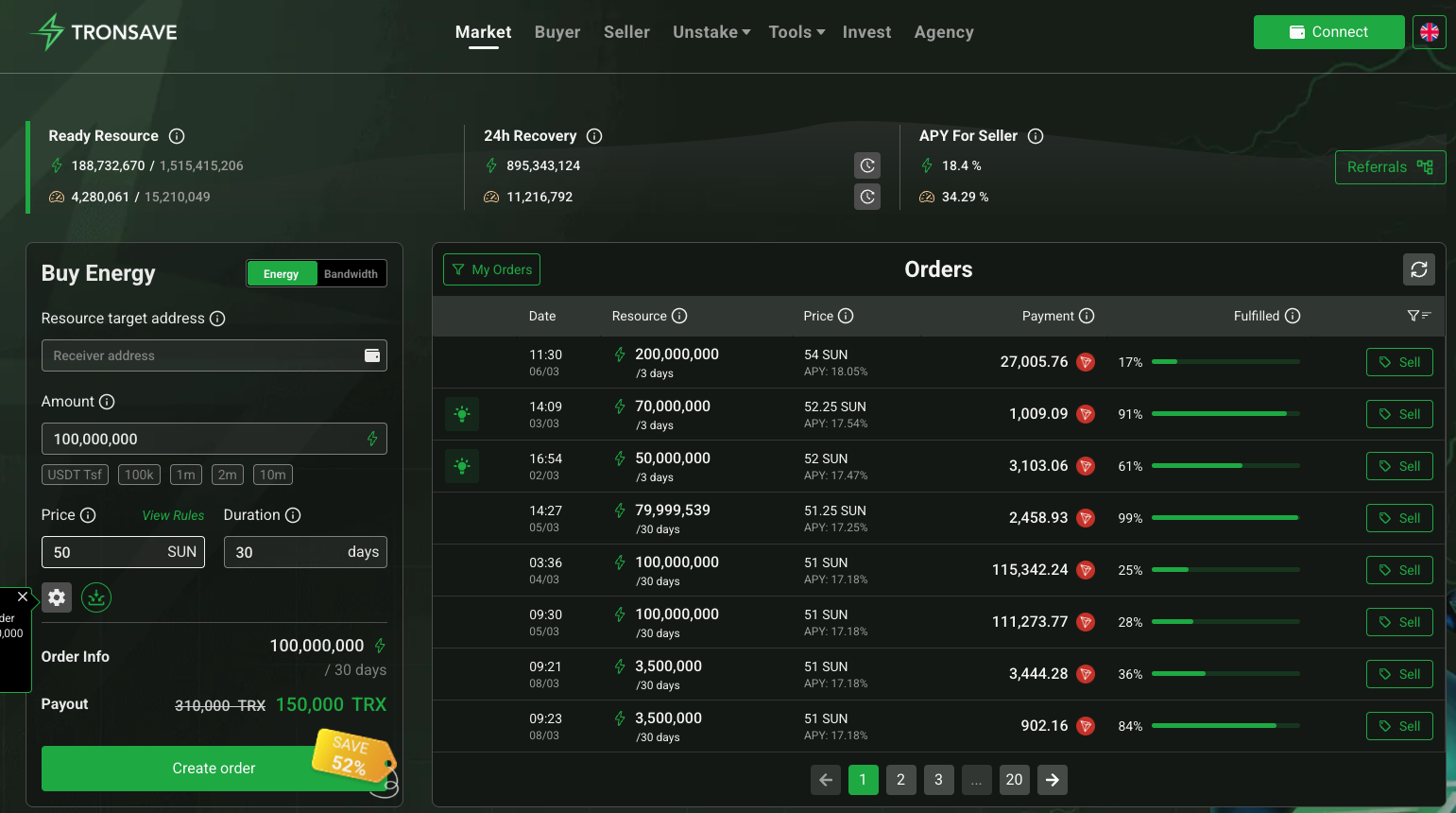
Want the cheapest option? See our ranked guide to the best TRON energy rental platforms in 2026.
What Are Tron Gas Fees and Why Are They So High?
On the TRON network there is no single “gas” fee. Instead, every transaction consumes two resources: Bandwidth (for transaction size) and Energy (for smart-contract execution, such as a USDT TRC20 transfer). When you don’t hold enough of these resources, the network burns your TRX to cover the cost — and that burn is what most users experience as a “gas fee.”
USDT transfers are contract calls, so they need a large amount of Energy. A transfer to a wallet that already holds USDT typically needs around 32,000 Energy; a transfer to an empty wallet needs roughly double. If you have no Energy, TRON burns TRX at the network’s Energy price, which is why a simple transfer can feel expensive. You can read the official mechanics in the TRON resource model documentation.
How Do You Reduce Tron Gas Fees with Energy Rental?
The core idea behind any effort to reduce Tron gas fees is simple: supply the Energy a transaction needs instead of burning TRX for it. Renting Energy from a marketplace means you pay a small TRX fee for a short-term allocation of Energy, which is usually far cheaper than the equivalent burn.
Platforms such as TronSave let you rent Energy on demand. Alternatives exist too — you can stake your own TRX, or use other Energy marketplaces. Here is the general flow:
- Check the requirement: Most USDT transfers need ~32,000 Energy (more for an empty recipient wallet).
- Rent the Energy: Order roughly the needed amount through an app, web market, Telegram bot, or API.
- Send your transaction: With Energy available, the network consumes it instead of burning TRX.
- Extend if needed: Some platforms let you extend a rental’s duration mid-use to finish a batch of transfers.
Renting vs. Staking: Which Is Cheaper for You?
Renting is not automatically the best option. Staking (freezing) TRX gives you recurring Energy for free, which suits heavy, daily users — but it locks up capital and you only recover the TRX after an unstaking period. Renting suits occasional or unpredictable usage. The table below compares the two approaches with illustrative figures.
| Method | Up-front cost | Best for | Trade-off |
|---|---|---|---|
| Burn TRX (no Energy) | ~13–28 TRX per USDT transfer (approx.) | One-off, rare transfers | Most expensive per transaction |
| Rent Energy | A few TRX per transfer (varies) | Occasional / variable usage | Pay each time; depends on market price |
| Stake (freeze) TRX | Lock a larger TRX amount | Frequent daily senders | Capital locked; unstaking delay |
Figures are approximate and for illustration only (as of 2026; verify against a primary source). Exact costs depend on the live Energy price and the TRX price.
When Is Renting NOT Cheaper Than Burning TRX?
It’s worth being honest about edge cases. Renting Energy may not save money when:
- You send very rarely: For a single tiny transfer, the convenience of just burning TRX can outweigh setup effort.
- Energy prices spike: During peak demand, market Energy prices rise and the gap versus burning narrows.
- You transact constantly: At high volume, staking your own TRX usually beats paying per-transaction rental fees.
- Minimum order sizes apply: If you only need a fraction of a marketplace’s minimum, you may overpay for unused Energy.
Can You Earn Income by Selling Energy?
If you stake TRX and don’t use all the Energy it generates, some marketplaces let you sell the surplus. This can produce modest passive income, but the amount is not guaranteed — it depends entirely on buyer demand and the prevailing Energy price. Treat any monthly earnings figure you see as illustrative, not a promise. Always weigh the locked-up capital against the income you might realistically earn.
How to Reduce Tron Gas Fees Step by Step
- Estimate the Energy you need — about 32,000 Energy for a USDT transfer to a funded wallet; more for an empty one.
- Choose your source — stake TRX yourself for ongoing needs, or rent from a marketplace such as TronSave for one-off needs.
- Acquire the Energy before sending, via app, web market, Telegram bot, or API.
- Send the transaction so the network uses Energy instead of burning TRX.
- Confirm the result by checking the transaction hash on TronScan to compare the actual fee before and after.
For deeper background, see our related guides on reducing Tron gas fees with easy tools and why renting TRON Energy reduces USDT fees fast.
Frequently Asked Questions
- What is the easiest way to reduce Tron gas fees? Supply Energy for your transaction instead of burning TRX — either by staking TRX or renting Energy from a marketplace.
- How much can I save? Up to around 80% versus burning TRX on a typical USDT transfer (varies with demand; verify on TronScan).
- How much Energy does a USDT transfer need? Roughly 32,000 Energy to a funded wallet, and about double to an empty wallet.
- Is renting always cheaper than staking? No. Renting suits occasional use; frequent daily senders usually save more by staking their own TRX.
- Can I earn money selling Energy? Possibly, but income is not guaranteed and depends on buyer demand and Energy prices.
- How do I verify the fee I actually paid? Look up your transaction hash on TronScan to see the real Energy used and any TRX burned.
⚠️ Not financial advice. This article is for educational and informational purposes only and reflects the author’s opinion at the time of writing. It is not investment, financial, legal, or tax advice. Cryptocurrency is highly volatile and you can lose your entire principal; prices, APYs, and on-chain fees change constantly and may be out of date. Always do your own research (DYOR) and consult a licensed financial advisor before buying, selling, staking, or lending any digital asset.
Disclosure: This is the official TronSave blog. TronSave sells TRON energy/resource (fee-reduction) services and has a commercial interest in the products and topics covered here.