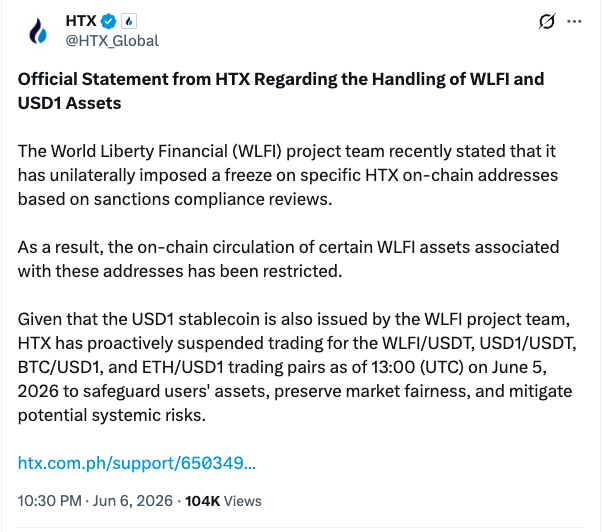
On June 8, 2026, HTX delisted the USD1 stablecoin, the dollar-pegged token backed by World Liberty Financial (WLFI), a project advised by Donald Trump and his sons. HTX says the move followed an alleged unilateral freeze of its on-chain addresses, escalating a public dispute between the exchange and the Trump-linked issuer.
Key Takeaways
- What happened: HTX delisted the USD1 stablecoin on June 8, 2026, suspending deposits, withdrawals, conversions, and related trading pairs.
- HTX’s claim: The exchange alleges WLFI froze its on-chain addresses without notice, legal grounds, or communication. These are HTX’s allegations, and WLFI has not directly confirmed them.
- User impact: HTX says USD1 balances will be auto-converted to Tether (USDT) at a 1:1 ratio, with timing announced later.
- Context: The dispute follows May 26, 2026 UK sanctions targeting an entity named “Huobi Global S.A.”, which HTX says is legally separate from the current exchange.
- Lesson: Issuer-controlled stablecoins carry counterparty and freeze risk, especially tokens tied to politically exposed persons.
What Does the HTX USD1 Stablecoin Delisting Mean?
A delisting means HTX removed the USD1 stablecoin from its platform, halting the ability to trade, deposit, withdraw, or convert the token through the exchange. According to HTX, all USD1-related services were suspended immediately to protect users after the alleged address freeze.
HTX stated that it could not tolerate a token issuer imposing restrictions without transparency or due process. The exchange said the freeze restricted circulation of WLFI-related assets, directly affecting user funds and platform operations. It is worth noting these are one party’s claims; WLFI has not issued a point-by-point confirmation.
Trading pairs reported as halted include WLFI/USDT, USD1/USDT, BTC/USD1, and ETH/USD1, a step HTX framed as preventing liquidity gaps and market volatility.
How Can a Stablecoin Issuer Freeze On-Chain Addresses?
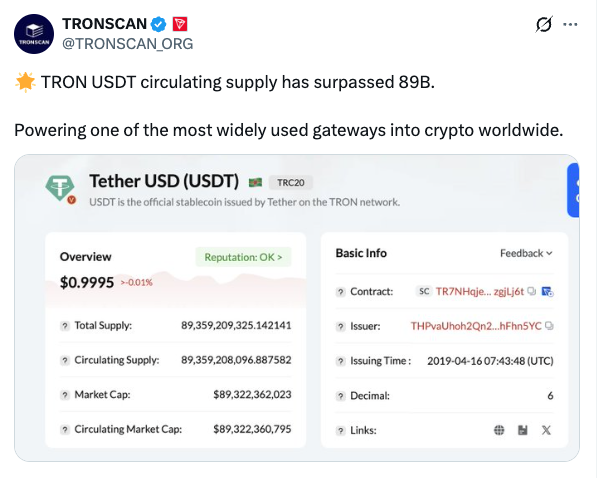
Many fiat-backed stablecoins, including USD1 and Tether’s USDT, are issued through smart contracts that give the issuer administrative controls. A common feature is a blocklist (sometimes called a “freeze” or “blacklist” function) that lets the issuer prevent specific wallet addresses from sending or receiving the token.
Here is what that practically means:
- The tokens stay on-chain but become non-transferable for the frozen address.
- The issuer, not a court alone, executes the action via a contract function, though issuers typically cite compliance or sanctions obligations.
- Centralized stablecoins differ from decentralized assets like native TRX or ETH, which no single party can freeze.
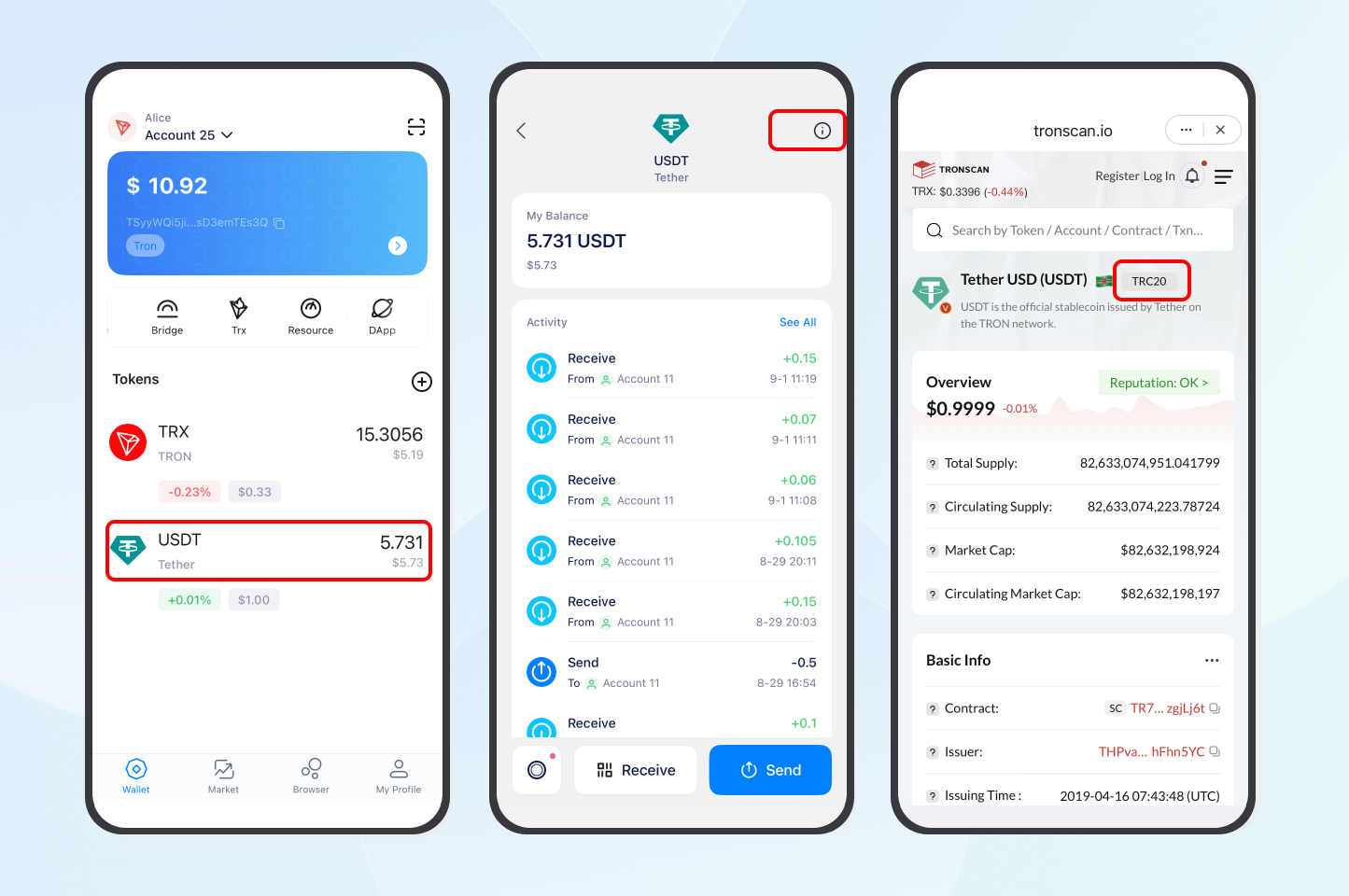
You can verify how a token contract behaves by inspecting it on a block explorer such as TronScan for TRON-based assets. For a deeper primer on resources and on-chain mechanics, see our guide on TRON energy and bandwidth.
Why Was the USD1 Stablecoin Controversial?
The conflict sits at the intersection of crypto operations, politics, and regulation. WLFI is publicly associated with Donald Trump and his sons, while HTX is associated with entrepreneur Justin Sun. That combination drew unusual attention to what might otherwise be a routine exchange dispute.
The timing also matters. On May 26, 2026, the United Kingdom imposed sanctions on an entity it identified in connection with HTX (formerly Huobi Global), alleging financial services were provided to the Russian government. HTX disputed this, stating the sanctioned “Huobi Global S.A.” is a separate legal entity from the current exchange.
Observers describe the standoff as more than a technical issue, framing it as a power struggle involving high-profile political figures and major industry players. As of mid-2026, key claims on both sides remain unverified by a neutral third party.
Timeline of the USD1 Stablecoin Dispute
| Date (2026) | Event (as reported) |
|---|---|
| May 26 | UK announces sanctions tied to an entity named “Huobi Global S.A.”; HTX says it is legally separate. |
| Early June | HTX alleges WLFI froze its on-chain addresses without notice. |
| June 8 | HTX delists the USD1 stablecoin; services and trading pairs suspended. |
| After June 8 | HTX says USD1 balances will convert to USDT 1:1; exact timing to be announced. |
Note: dates and claims above reflect HTX’s public framing and reporting at the time; verify against primary sources before acting.
What Should Affected Users Do?
If you held USD1 or WLFI pairs on HTX, the 1:1 USDT conversion means your dollar value is intended to be preserved, but practical caution still applies. Consider these steps:
- Read HTX’s official announcement directly rather than relying on summaries, and confirm conversion timing and any required action.
- Check your balances and transaction history after any auto-conversion completes.
- Verify on-chain using a block explorer if you self-custody related assets.
- Understand counterparty risk: centralized exchanges and issuers can change terms quickly. Diversifying custody and using well-audited stablecoins reduces single-point exposure.
- Compare your options for managing TRON-network costs. If you transact frequently, fee-reduction approaches like staking TRX for resources yourself, or services such as TronSave and other resource providers, can lower transfer costs, separate from this dispute.
Centralized vs. Decentralized Stablecoin Risk
- Centralized stablecoins (e.g., USD1, USDT): backed by reserves, redeemable, but the issuer can freeze addresses.
- Decentralized/crypto-collateralized options: harder to freeze, but carry smart-contract and peg-stability risks.
- Native assets (TRX, ETH): not freezable by an issuer, but volatile and not dollar-pegged.
Frequently Asked Questions
Why did HTX delist the USD1 stablecoin?
HTX says it delisted USD1 after alleging that World Liberty Financial froze its on-chain addresses without notice or legal grounds. This is HTX’s stated reason; WLFI has not confirmed the specifics.
Will I lose money if I held USD1 on HTX?
HTX states USD1 balances will be converted to USDT at a 1:1 ratio, so the intended dollar value is preserved. Confirm timing and details in HTX’s official announcement, and verify your own balance.
What is USD1?
USD1 is a dollar-pegged stablecoin backed by World Liberty Financial, a project advised by Donald Trump and his sons. Like other fiat-backed tokens, its contract can include issuer freeze controls.
Can any stablecoin issuer freeze my funds?
Many centralized stablecoins, including USDT, include blocklist functions that let the issuer freeze specific addresses, typically citing compliance. Decentralized assets like TRX are not freezable this way.
Are the UK sanctions related to the freeze?
The May 26, 2026 UK sanctions targeted an entity HTX says is legally separate (“Huobi Global S.A.”). Whether the events are connected is unconfirmed; observers note the close timing but no neutral source has established a direct link.
What did WLFI say in response?
As of reporting, WLFI had not issued a direct point-by-point response to the specific address freezes, stating only that it maintains “risk-based sanctions compliance controls.” Treat both sides’ statements as claims pending independent verification.
⚠️ Not financial advice. This article is for educational and informational purposes only and reflects the author’s opinion at the time of writing. It is not investment, financial, legal, or tax advice. Cryptocurrency is highly volatile and you can lose your entire principal; prices, APYs, and on-chain fees change constantly and may be out of date. Always do your own research (DYOR) and consult a licensed financial advisor before buying, selling, staking, or lending any digital asset.
Disclosure: This is the official TronSave blog. TronSave sells TRON energy/resource (fee-reduction) services and has a commercial interest in the products and topics covered here.