Tron voting rewards are the TRX you earn for staking TRX and voting for Super Representatives (SRs) on the TRON network. Native voting yields typically land around 4-5% APY in 2026. Pairing votes with renting out your idle energy can lift the blended return higher, though rental income varies and is never guaranteed.
Key Takeaways
- Tron voting rewards come from staking TRX (Stake 2.0) and voting for Super Representatives under TRON’s Delegated Proof-of-Stake (DPoS) model.
- Native voting APR is variable, usually about 4-5% as of 2026 (verify against a primary source); it is not fixed.
- Each SR sets a brokerage (commission) ratio that directly reduces your take-home rewards.
- Rewards do not auto-compound and can be claimed once every 24 hours, so claim and re-stake regularly.
- Staking also grants daily Energy and Bandwidth; renting these out can add a second, demand-dependent income stream that may approach a higher blended APY (varies; can be near 0%).
- Unstaking under Stake 2.0 has a 14-day unbonding period during which funds earn nothing.
What are Tron voting rewards and how do they work in Stake 2.0?
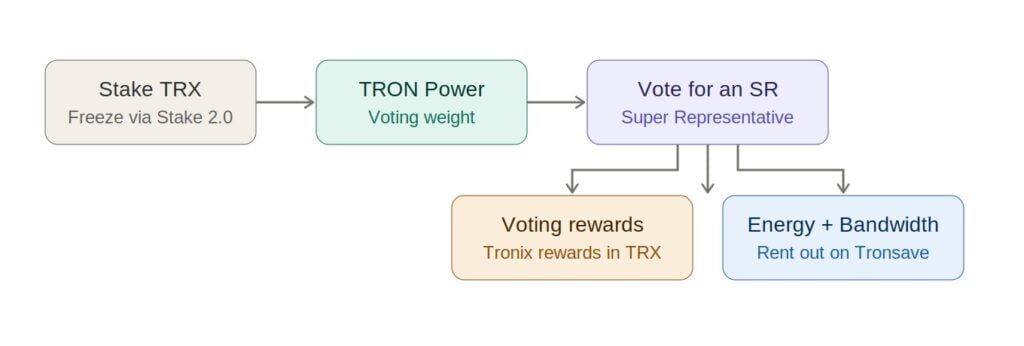
Tron voting rewards are the TRX you receive for staking TRX and voting for Super Representatives. TRON runs on a Delegated Proof-of-Stake (DPoS) consensus: token holders freeze TRX to gain Tron Power, then vote for validators. In return, validators share part of their block earnings with voters.
There are two reward types worth separating:
- Block Rewards – paid to the 27 active Super Representatives for producing blocks.
- Voting Rewards – the TRX that SRs and SR Partners distribute back to the voters who supported them.
Two practical details matter most. First, every SR sets a brokerage ratio – essentially their commission. An SR keeping 20% means you take home only 80% of your share, so your choice of validator directly affects your real yield. Second, rewards do not auto-compound; you must claim them yourself, and only once every 24 hours. You can confirm the consensus mechanics and SR list on the official TRON staking documentation and live data on TronScan.
How do you use a Tron voting rewards calculator to estimate earnings?
Before committing any TRX, model your expected return. Native TRON yields are not fixed – they shift with total stake, voter participation, and the brokerage fee of the SR you back. The figure usually lands in a modest 4-5% APY range (as of 2026; verify against a primary source).
A reputable tool such as TronScan or StakingRewards gives you a realistic baseline. Enter your TRX amount and you will see roughly your daily rewards, plus the Energy and Bandwidth you generate each day.
A simple worked example
To show how the math works (illustrative only – your actual numbers depend on live rates):
- Suppose you freeze 100,000 TRX and vote for an SR charging a 20% brokerage.
- At an approximate 5% gross native APR, gross annual voting rewards are about 5,000 TRX; after the 20% brokerage you keep roughly 4,000 TRX (~4% net).
- That same stake also generates daily Energy and Bandwidth. If you rent the surplus, the rental fees add a separate stream – but that amount swings with market demand and can be near zero in slow periods.
A standard Tron voting rewards calculator measures only the voting yield; it ignores the resources you receive free each day. Relying on that number alone may understate (or overstate) your real potential income.
Can renting idle energy and bandwidth raise your blended APY?
When you freeze TRX for Tron Power, the network hands you two things at once: voting weight and a daily allowance of Energy and Bandwidth. Most users tap only the first. These resources normally pay for transactions and smart-contract calls; if you do not trade constantly, the allowance expires unused each day.
The fix is to monetize that surplus. dApps, traders, and projects are often short on Energy and Bandwidth and willing to rent it. Resource marketplaces and staking platforms let you list your unused share. TronSave is one such marketplace, but it is not the only path – you can also delegate resources directly, use other rental platforms, or simply continue native staking if you prefer simplicity. Whichever route you choose, rental income is demand-dependent and not guaranteed.
Voting only vs. voting plus renting
| Method | Indicative APY | Resource use | Effort |
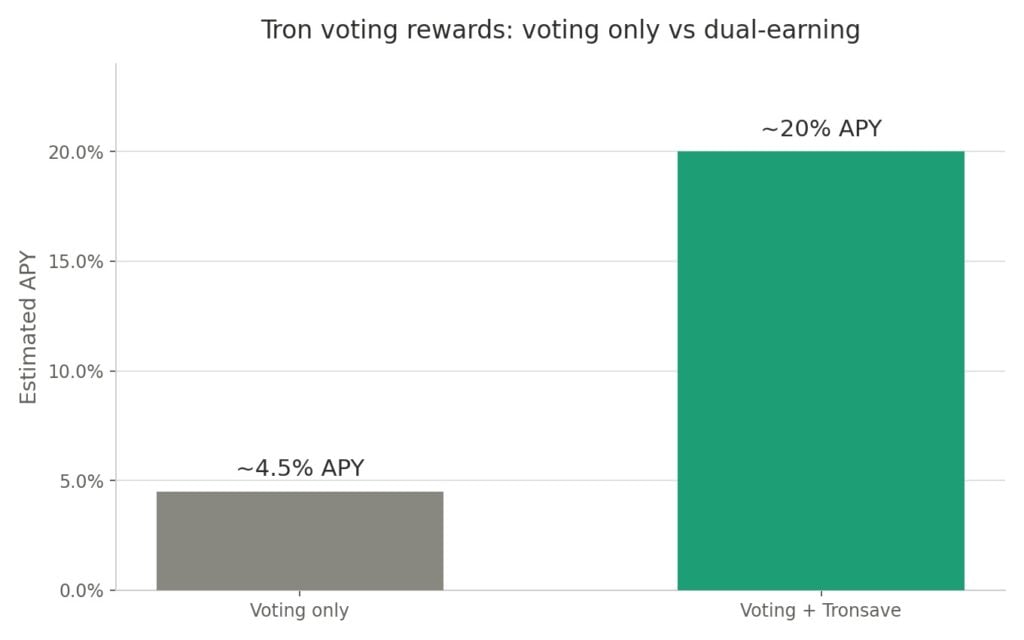
| Voting only | ~4-5% (variable) | Energy/Bandwidth wasted | Low |
| Voting + renting idle resources | Potentially higher blended yield (varies; can be ~0% extra in low demand) | Surplus resources monetized | Medium |
Same capital, same lock-up – you are simply not leaving idle resources unused. Any “up to ~20%” headline figure is a best-case scenario that depends on sustained high rental demand and the TRX price; treat it as a ceiling, not a promise.
What should you watch out for to keep rewards flowing?
A high yield only matters if it is sustainable. A few practical rules help. This is not financial advice.
Managing the unbonding period
Under Stake 2.0, unstaking is not instant. When you unfreeze TRX, there is a 14-day unbonding period before you can withdraw, and the funds earn nothing during that window. Plan your liquidity accordingly. If you only want to support a different validator, you can redelegate your votes to a new SR without unstaking or waiting 14 days, so your rewards continue uninterrupted.
Compounding frequency
Because TRON does not auto-compound, your habits shape the growth curve. Claim and re-stake rewards regularly rather than letting them sit idle. Re-staking increases your Tron Power, which raises the next period’s payout. Over a year, the compounding gap is meaningful.
Risk reminders
- APY is variable, not guaranteed; rental demand can fall to near zero.
- TRX price movements affect your real returns in fiat terms.
- Smart-contract and platform risk applies to any third-party marketplace.
Frequently asked questions about Tron voting rewards
How often can I claim Tron voting rewards?
You can claim once every 24 hours. Rewards do not auto-compound, so claiming and re-staking regularly is what builds your Tron Power over time.
What APY do Tron voting rewards pay?
Native voting yields are typically around 4-5% APY as of 2026 (verify against a primary source). The exact figure depends on total network stake, voter participation, and your SR’s brokerage.
What is a brokerage ratio?
It is the commission an SR keeps from rewards before distributing the rest to voters. A 20% brokerage means you receive 80% of your share, so lower-brokerage SRs generally pay voters more.
Is the “up to 20% APY” figure realistic?
It is a best-case ceiling that assumes strong, sustained demand for rented Energy and Bandwidth on top of native voting yield. In low-demand periods the rental component can be near zero, so do not treat it as guaranteed.
How long does it take to unstake TRX?
Stake 2.0 enforces a 14-day unbonding period during which the TRX earns nothing. Redelegating votes to another SR, however, is immediate and avoids the wait.
Do I need a calculator before staking?
It helps. A TronScan or StakingRewards calculator gives a realistic baseline for your daily and annual rewards so you can compare SRs and plan with data instead of guesswork.
⚠️ Not financial advice. This article is for educational and informational purposes only and reflects the author’s opinion at the time of writing. It is not investment, financial, legal, or tax advice. Cryptocurrency is highly volatile and you can lose your entire principal; prices, APYs, and on-chain fees change constantly and may be out of date. Always do your own research (DYOR) and consult a licensed financial advisor before buying, selling, staking, or lending any digital asset.
Disclosure: This is the official TronSave blog. TronSave sells TRON energy/resource (fee-reduction) services and has a commercial interest in the products and topics covered here.