You rent TRON energy to avoid burning TRX on every USDT TRC20 transfer. Instead of paying the network’s TRX burn fee, you pay a small rental cost for a short period, which can reduce the per-transfer cost of a USDT send by roughly 60–80% as of 2026 (verify against live rates).
Key Takeaways
- Big fee savings: Renting energy is typically far cheaper than letting the network burn TRX for a USDT transfer.
- Instant and flexible: Rented energy usually arrives in seconds and needs no 14-day TRX lock.
- Two valid paths: Renting suits occasional senders; staking (Stake 2.0) often wins for heavy daily volume.
- Use non-custodial tools: Reputable platforms delegate energy via smart contracts and never need your private keys.
- Always verify: Confirm delegated energy and fees on tronscan.org before trusting any provider.
👉 Try it free: use the USDT Fee Savings Calculator to see exactly how much you’d save by renting TRON energy instead of burning TRX.
What Is TRON Energy and Why Does It Matter?
TRON energy is the resource that powers smart-contract execution on the TRON network, including USDT TRC20 transfers. When your wallet lacks enough energy, the network automatically burns TRX to cover the cost. A single USDT transfer can burn meaningfully more TRX when the recipient address has never held USDT, because creating that token balance consumes extra energy.
Energy is distinct from bandwidth. You can review the exact mechanics in the official TRON developer resource model docs. Because there is no free daily energy allowance, every smart-contract user must either stake TRX or rent TRON energy to avoid the TRX burn.
Energy vs. Bandwidth at a Glance
| Resource | Powers | Free daily allowance | Used by USDT transfer? |
| Bandwidth | Simple TRX transfers | ~600 units/day | Small amount |
| Energy | Smart contracts (USDT TRC20) | None | Yes — the main cost |
How Do You Rent TRON Energy Step by Step?
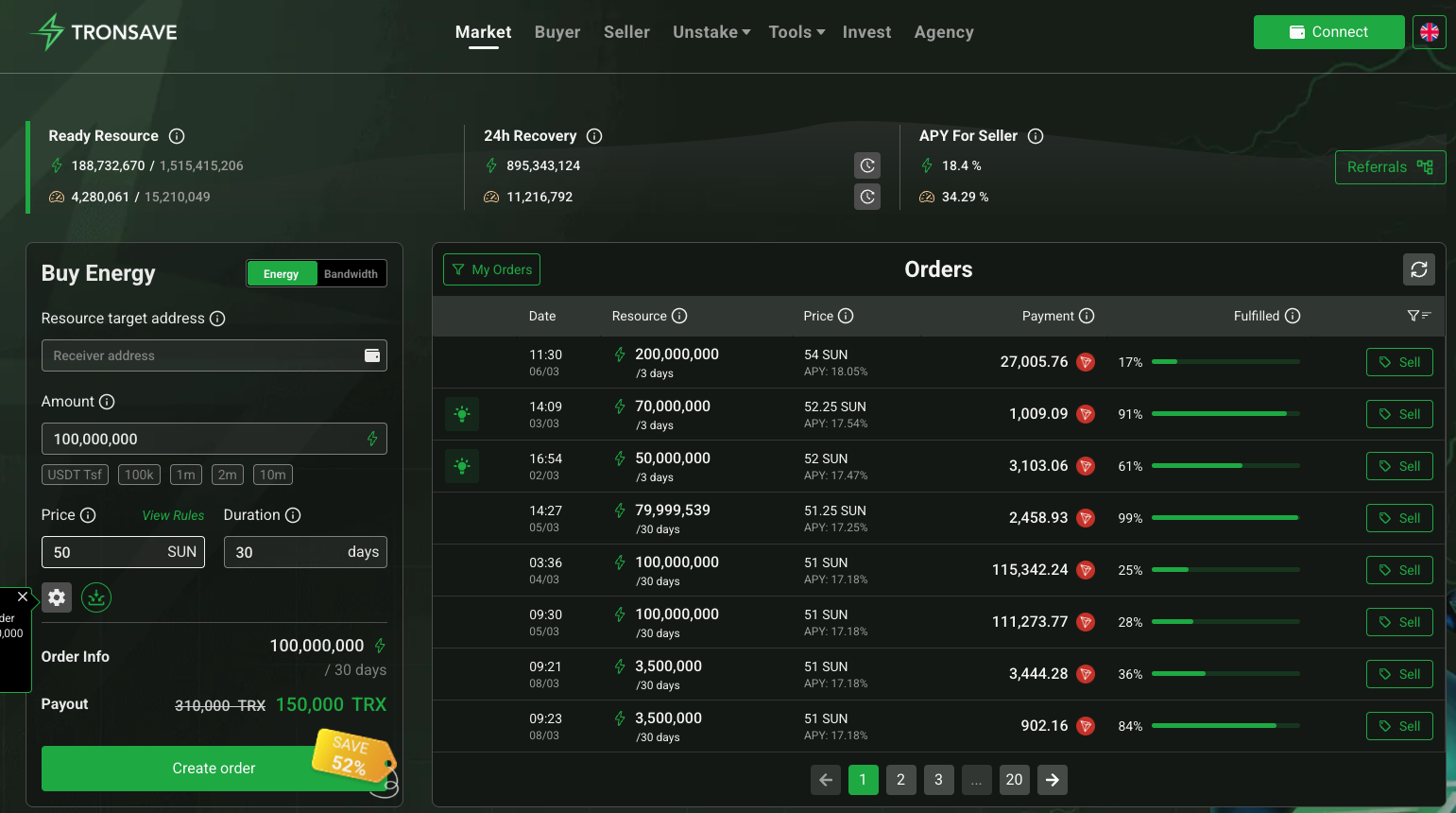
The process is similar across most providers. Here is a clear, platform-neutral walkthrough you can follow with a tool like TronSave, Feee.io, or any non-custodial energy market.
- Set up a TRON wallet: Install TronLink or imToken and fund it with a little TRX.
- Keep a small TRX buffer: Hold enough TRX to cover the rental fee plus bandwidth (a few TRX is usually plenty as of 2026; verify current rates).
- Open a trusted energy market: Visit a reputable platform and find the “Rent Energy” option.
- Choose the energy amount: Select enough energy to cover a USDT transfer to any recipient, including new addresses, so you avoid the “OUT_OF_ENERGY” error.
- Pay via smart contract: Approve the transaction in your wallet. You never share private keys.
- Verify delegation on TronScan: Open your address on tronscan.org and check the “Resources” tab to confirm the delegated energy arrived.
- Send your USDT: Complete the transfer while the rented energy is active.
Pro tip: If you rent too little energy, the transfer can still burn TRX. When you rent TRON energy, size the order for the worst case (a brand-new recipient address) so the send completes cleanly.
Renting vs. Staking: Which Saves More?
Renting is not always the right answer. Staking TRX through Stake 2.0 gives you recurring daily energy and votes, which can be cheaper over time if you transact frequently. The trade-off is liquidity: staked TRX is locked and takes days to unfreeze.
| Method | Up-front cost | Speed | Liquidity | Best for |
| Rent energy | Low, per use | Seconds | High (no lock) | Occasional / variable senders |
| Stake TRX (Stake 2.0) | High, recurring yield | Days to set up | Low (lock-up) | High daily volume |
| Burn TRX (do nothing) | Highest per transfer | Instant | High | Rare one-off sends |
Honest guidance: if you send USDT many times per day, run the numbers on staking first. If you send occasionally or your volume swings, renting usually wins because you pay only when you transact.
Which Platforms Let You Rent TRON Energy?
For a full ranked comparison, see our guide to the best TRON energy rental services in 2026.
Several non-custodial energy markets compete on price, minimum order size, and duration options. The table below is directional; always confirm live fees on each site, since prices float with the TRX market.
| Platform | Duration options | Notable feature |
| TronSave | Short-term to ~30 days | Bulk-order discounts; simple interface |
| Feee.io | Minutes to ~1 month | Peer-to-peer (C2C) energy trading |
| Other API providers | Varies | Programmatic energy for dApp developers |
- Compare total cost: Factor in minimum order size, not just the headline TRX rate.
- Check duration fit: Hourly rentals suit one-off sends; longer terms suit recurring activity.
- Read recent reviews: Skip platforms with no track record or no verifiable contract address.
How Do You Rent TRON Energy Safely?
Energy rental is low-risk when you stick to verified, non-custodial tools, but scam sites do exist. Follow these practices:
- Use non-custodial platforms: Energy should be delegated by smart contract — no provider needs your keys.
- Verify the contract: Look up the provider’s contract address on tronscan.org before paying.
- Test small first: New users can practice on TRON’s Shasta testnet to avoid real-TRX mistakes.
- Keep a buffer: Hold spare TRX in case a rental fails during network congestion.
- Avoid unverifiable claims: Be wary of platforms promising rates that seem far below the market.
For deeper background, see our guides on cutting USDT transfer costs and the TRON energy and bandwidth calculator.
FAQs: Renting TRON Energy in 2026
- How much energy does a USDT TRC20 transfer need? Enough to cover the worst case — a transfer to a brand-new address. Sizing your rental for that avoids the “OUT_OF_ENERGY” error. Confirm current unit requirements on a live calculator.
- How long does rented energy last? Typically from about one hour up to roughly 30 days, depending on the platform and plan you choose.
- Is it safe to rent TRON energy? Yes, when you use verified non-custodial platforms and confirm delegation on TronScan. The provider never touches your private keys.
- Can I rent energy for other smart contracts? Yes. Energy powers DeFi, NFT, and other dApp interactions, not just USDT transfers.
- Is renting always cheaper than staking? No. For very high daily volume, staking TRX can cost less over time. Renting wins for occasional or variable usage.
- What happens if a rental fails? Keep a small TRX buffer and try another reputable platform; failures usually trace back to network congestion.
Conclusion
Choosing to rent TRON energy is one of the simplest ways to stop overpaying on USDT TRC20 transfers, especially if your volume is occasional or unpredictable. Compare renting against staking for your own usage, use only verified non-custodial platforms such as TronSave or Feee.io, and always confirm results on TronScan. Verify all current prices against a primary source before you transact, since TRX-denominated costs move with the market.
⚠️ Not financial advice. This article is for educational and informational purposes only and reflects the author’s opinion at the time of writing. It is not investment, financial, legal, or tax advice. Cryptocurrency is highly volatile and you can lose your entire principal; prices, APYs, and on-chain fees change constantly and may be out of date. Always do your own research (DYOR) and consult a licensed financial advisor before buying, selling, staking, or lending any digital asset.
Disclosure: This is the official TronSave blog. TronSave sells TRON energy/resource (fee-reduction) services and has a commercial interest in the products and topics covered here.