Does staking TRX provide energy or bandwidth? Yes. When you stake (freeze) TRX on the TRON network you choose one resource per stake: energy for smart-contract and TRC-20 transactions, or bandwidth for ordinary transfers. A single stake never produces both at once, but you can split your TRX across two stakes to get a mix.
Key takeaways
- One stake, one resource: each frozen amount of TRX yields either energy or bandwidth, set by you at stake time.
- Energy powers TRC-20 (USDT) transfers and dApp calls; bandwidth covers basic TRX/TRC-10 sends and voting.
- No fee burn: enough of the right resource means a transaction costs 0 TRX instead of burning TRX.
- Stake 2.0 lets you reallocate between energy and bandwidth instantly; withdrawing the underlying TRX takes a 14-day unstaking period.
- Short on resources? You can also rent energy on demand rather than locking a large TRX balance.
👉 Try it free: use the USDT Fee Savings Calculator to see exactly how much you’d save by renting TRON energy instead of burning TRX.
Want more from your stake? Learn how to maximize your TRX staking APY.
Does staking TRX provide energy or bandwidth, and what is the difference?
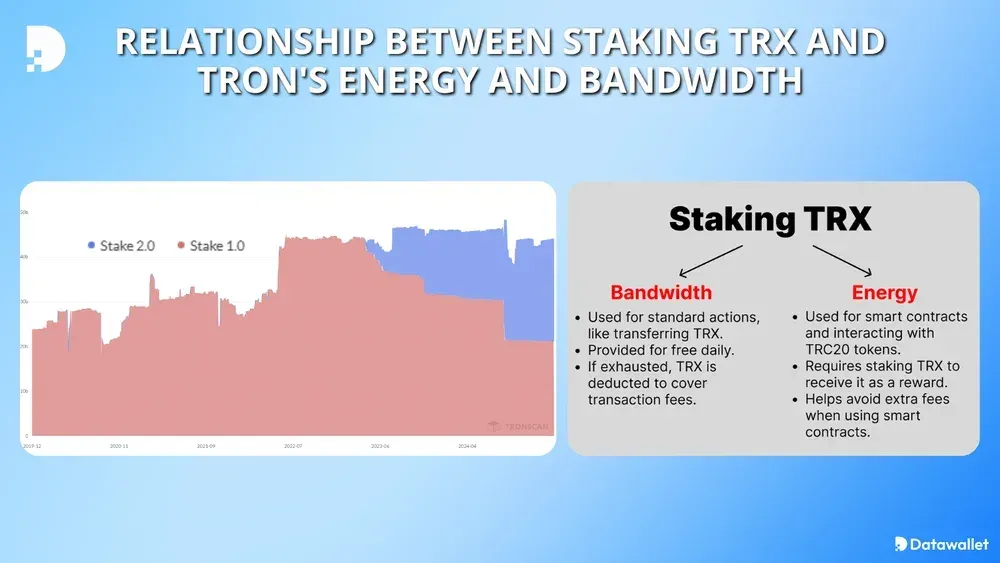
TRON meters two separate resources (see our primer on TRON energy and bandwidth). Bandwidth is consumed by the data size of a transaction (a normal TRX or TRC-10 transfer). Energy is consumed by computation inside smart contracts, including every TRC-20 token transfer such as USDT. Staking TRX generates one resource type per freeze, so you decide which one you need.
| Resource | Used for | Free daily allowance | Approx. from staking |
| Bandwidth | TRX / TRC-10 sends, voting | ~600 points | 1 TRX ≈ 66–68 points |
| Energy | TRC-20 (USDT) transfers, dApp calls | 0 | 1 TRX ≈ 210–230 units |
Exact ratios float with total network staking and are published live on the TronScan resource and staking dashboard and the official TRON resource model documentation. Treat the figures above as 2026 estimates and verify against those primary sources before sizing a stake.
How does staking TRX give you energy?
Choosing energy when you freeze TRX is the option most active users want, because TRC-20 transactions are energy-heavy. A single USDT transfer consumes roughly 65,000 energy; if your reserve is short, the network burns TRX to cover the gap (commonly in the low tens of TRX during busy periods).
How much TRX should you stake for energy?
- ~2,000 TRX → roughly one small USDT transfer per day.
- ~8,000 TRX → several daily transfers or light dApp use.
- 30,000 TRX+ → heavy daily DeFi activity (real capacity varies with network conditions and energy prices).
Under Stake 2.0 you can move capacity between energy and bandwidth from your wallet (in TronLink: Resources → adjust ratio) without unstaking the TRX itself.
How does staking TRX give you bandwidth?
Choosing bandwidth suits wallets that mostly send plain TRX or vote for Super Representatives. A standard TRX transfer needs about 270 bandwidth points, and the network already grants roughly 600 free points per day — enough for around two sends before any staking. Freezing about 10,000 TRX adds on the order of 670,000 bandwidth, comfortably covering thousands of daily transfers without touching your TRX balance.
Stake 2.0 vs legacy freezing: what changed?
| Feature | Legacy (pre-2022) | Stake 2.0 (current) |
| Switch resource type | Unfreeze + 3-day wait | Instant reallocation slider |
| Partial unfreeze | Not supported | Supported |
| Unstaking (withdraw TRX) | 3-day wait | 14-day waiting period |
| Voting rights | Retained | Retained |
| Minimum stake | 1 TRX | 1 TRX |
Note: the Stake 2.0 slider changes which resource your stake produces instantly, but unstaking is separate — withdrawn TRX is subject to a 14-day waiting period before it returns to your spendable balance.
How do you stake TRX step by step in 2026?
- Pick a wallet – TronLink, Trust Wallet, or a Ledger viewed through TronScan.
- Hold some TRX – via an exchange withdrawal or a cross-chain swap.
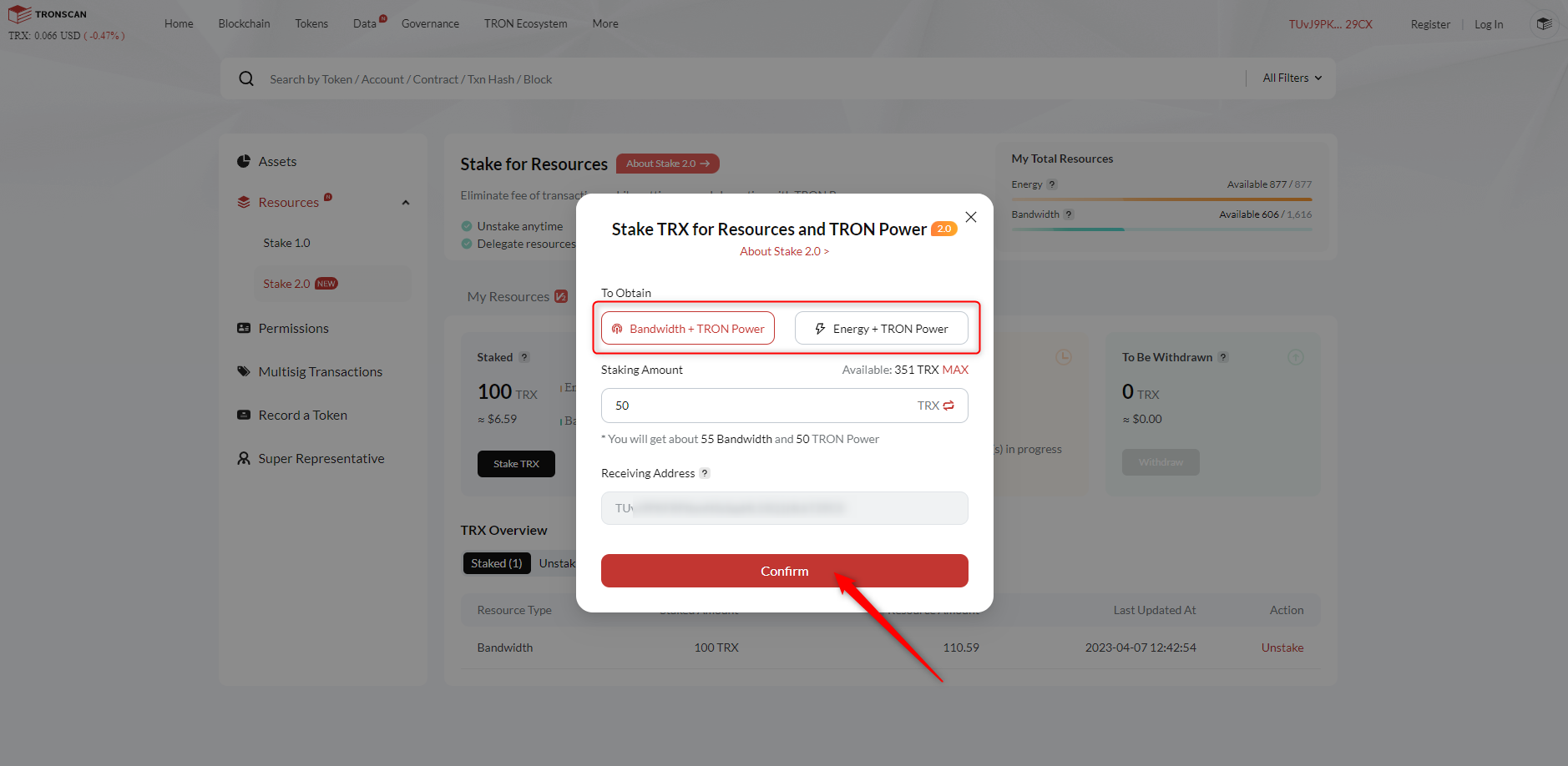
- Open the staking menu – select TRX → Freeze/Stake.
- Choose the resource – energy for USDT/dApps, bandwidth for simple sends.
- Confirm the stake – resources activate within minutes.
- Watch the daily reset – free allowances refill at 00:00 UTC.
Staking vs renting energy: which should you choose?
Staking is ideal if you want a permanent resource base and plan to hold TRX anyway, since it is free to maintain and keeps your voting power. Renting suits users who only need energy occasionally and prefer not to lock a large TRX balance for the 14-day unstaking window. Services such as TronSave let you rent energy on demand; for steady, predictable usage, staking your own TRX is usually the cheaper long-term route. Many users combine both: a base stake for daily needs plus occasional rentals for spikes.
FAQ: staking TRX for energy and bandwidth
Can a single TRX stake give both energy and bandwidth at once?
No. Each stake produces one resource. Split your TRX across two stakes, or use the Stake 2.0 slider, to hold a mix.
Does staking TRX still earn voting rewards?
Yes. Staked TRX grants TRON Power for voting regardless of whether you chose energy or bandwidth.
What happens if I run out of energy or bandwidth?
The network burns a small amount of TRX to complete the transaction. Staking more, or renting energy, prevents the burn.
What is the minimum stake?
1 TRX technically, though roughly 1,000+ TRX produces resources useful for everyday transfers.
How long until I can withdraw staked TRX?
After you unstake, the TRX is locked for a 14-day waiting period before it becomes spendable.
Do exchanges show staked TRX?
Self-custody staking happens in your own wallet; balances are labelled “frozen” or “staked” and remain yours.
Conclusion
So, which resource does staking give you? Whichever you select — energy for smart-contract and USDT activity, or bandwidth for everyday transfers — one resource per stake, switchable under Stake 2.0. Match the resource to how you actually use TRON, and rent energy only when your staked base falls short.
⚠️ Not financial advice. This article is for educational and informational purposes only and reflects the author’s opinion at the time of writing. It is not investment, financial, legal, or tax advice. Cryptocurrency is highly volatile and you can lose your entire principal; prices, APYs, and on-chain fees change constantly and may be out of date. Always do your own research (DYOR) and consult a licensed financial advisor before buying, selling, staking, or lending any digital asset.
Disclosure: This is the official TronSave blog. TronSave sells TRON energy/resource (fee-reduction) services and has a commercial interest in the products and topics covered here.