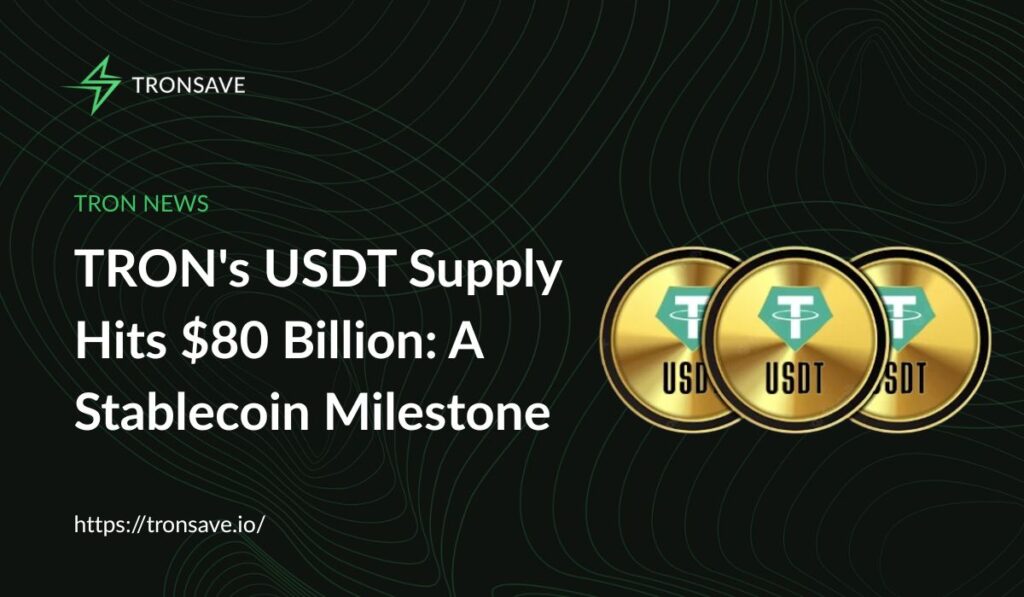
The TRON USDT supply has climbed to roughly $80 billion in circulating TRC-20 Tether, based on CryptoQuant and TronScan data (as of 2026; verify against a primary source). That figure makes TRON one of the largest networks for stablecoin settlement, reflecting steady demand for low-cost, fast USDT transfers.
Key Takeaways
- The TRON USDT supply sits near $80 billion in TRC-20 Tether (as of 2026; verify with TronScan).
- Growth accelerated sharply through 2021 and again during the 2025 cycle, with steady demand even in flat markets.
- TRON’s appeal centers on low fees and fast settlement versus higher gas costs on some other chains.
- Cross-chain bridges and native Tether issuance support continued USDT liquidity on TRON.
- Always verify point-in-time figures against primary on-chain sources before acting on them.
What is driving the TRON USDT supply to $80 billion?
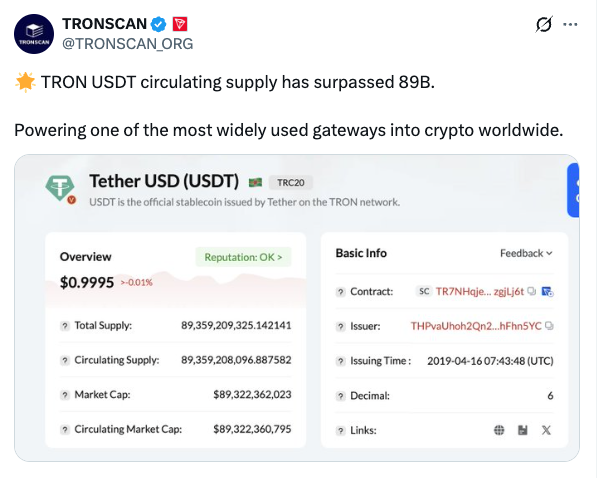
USDT (Tether) is the most widely used stablecoin, and the TRC-20 version issued on TRON has become a default rail for moving dollars on-chain. The TRON USDT supply reflects how much TRC-20 Tether is in circulation on the network. Demand is driven mainly by:
- Low transfer costs: sending USDT on TRON is typically inexpensive compared with networks where gas spikes during congestion.
- Fast settlement: TRON blocks confirm quickly, which suits payments and remittances.
- Wide exchange and wallet support: most major platforms list TRC-20 USDT for deposits and withdrawals.
- Native issuance: Tether mints USDT directly on TRON, keeping liquidity deep.
For background on the token standard itself, see our explainer on what TRC-20 USDT is.
How has the TRON USDT supply grown since 2020?
TRON’s stablecoin footprint expanded dramatically over several market cycles. According to circulating-supply figures (verify against TronScan), the trajectory looked roughly like this:
| Period | Approx. TRC-20 USDT supply | Notes |
|---|---|---|
| Early 2021 | ~$6.7 billion | Start of a major expansion year |
| End 2021 | ~$39.4 billion | Large year-over-year increase during the bull cycle |
| 2022–2023 | Steady, rising | Demand held up even in bearish/neutral markets |
| 2025 | ~$60B → ~$80B | New highs during the 2025 cycle (as of 2026; verify) |
The pattern stands out because the supply kept rising even when prices fell. That suggests the demand is utility-driven — people using USDT for payments, savings, and trading — rather than purely speculative. For a related look at on-chain momentum, see how TRON dominates global stablecoin transfers.
Did TRON overtake Ethereum in USDT circulation?
TRON has at various points held a leading share of total USDT circulation, reportedly surpassing Ethereum’s USDT footprint during the 2025 cycle (historical event; verify exact dates and figures). The shift reflects user preference for lower fees and quicker settlement for everyday transfers.
This does not mean Ethereum’s role disappeared — both chains carry large USDT volumes, and many users move between them. Bridges connect TRON to Ethereum, Arbitrum, TON and others, so liquidity is increasingly multi-chain rather than locked to one network.
TRON vs. Ethereum for USDT transfers
A common question is which network is better for moving Tether. The answer depends on cost sensitivity, speed needs, and where your counterparties hold funds.
| Factor | TRON (TRC-20) | Ethereum (ERC-20) |
|---|---|---|
| Typical transfer fee | Low | Variable; can spike when congested |
| Settlement speed | Fast | Slower under load |
| Liquidity | Very deep for USDT | Very deep, broad DeFi access |
| Best for | Frequent, cost-sensitive transfers | DeFi composability, ERC-20 ecosystems |
For a deeper comparison, read our guide on TRON vs. Ethereum for USDT.
How do fees work when sending USDT on TRON?
On TRON, USDT transfers consume energy and bandwidth rather than a simple gas fee. You can cover these costs in a few ways:
- Burn TRX: the simplest method, but it can be the most expensive per transfer when energy is scarce.
- Stake (freeze) TRX: staking your own TRX to earn energy reduces ongoing costs if you transact often.
- Rent energy: energy-market platforms let you lease energy short-term, which can lower the cost of an individual USDT transfer.
Tools like TronSave operate in this energy-market category alongside self-staking and other providers; which approach is cheapest depends on how frequently you send USDT and current network conditions. Always compare options for your own usage pattern. To understand the mechanics, see how much TRX is needed to send USDT.
Why does the $80 billion milestone matter?
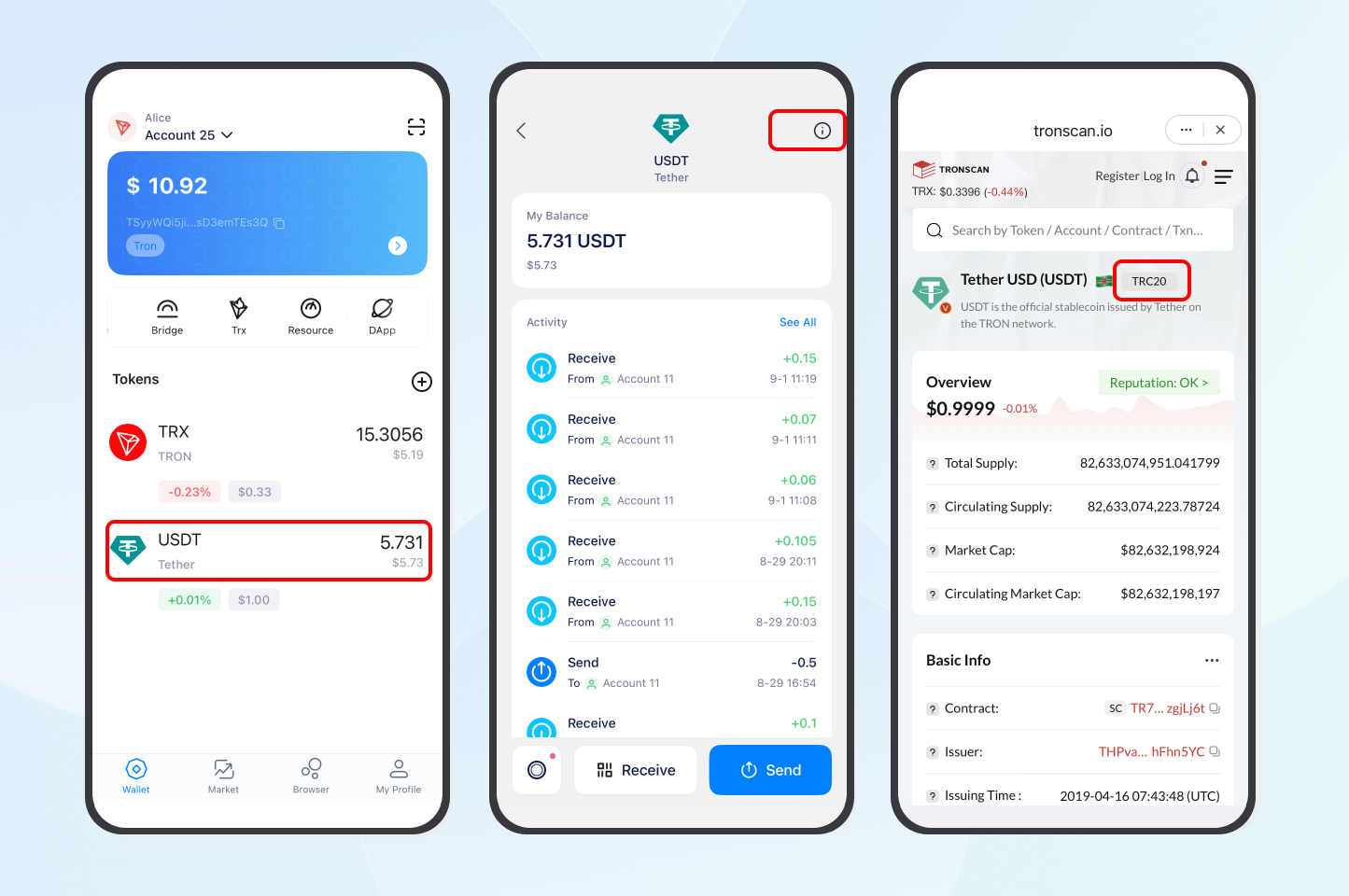
A larger TRON USDT supply signals that more dollar-denominated value settles on the network, which tends to reinforce liquidity, exchange support, and integrations. Practical implications include:
- Deeper USDT liquidity for traders and businesses.
- More predictable on/off ramps across exchanges and wallets.
- Continued investment in cross-chain bridges and payment tooling.
For authoritative, real-time figures, you can check Tether’s own transparency data at tether.to and verify on-chain TRC-20 supply via TronScan.
Frequently Asked Questions
What is the current TRON USDT supply?
It is approximately $80 billion in TRC-20 Tether (as of 2026; verify against TronScan or Tether’s transparency page, since point-in-time figures change constantly).
Why is USDT so popular on TRON?
Low transfer fees, fast settlement, broad exchange support, and Tether’s native issuance on the network make TRC-20 USDT a practical choice for everyday transfers.
Is sending USDT on TRON cheaper than on Ethereum?
Often yes, especially when Ethereum gas is elevated. TRON uses energy and bandwidth, and costs can be reduced by staking TRX or renting energy.
Did TRON really pass Ethereum in USDT circulation?
TRON has held a leading share of USDT circulation at points during recent cycles. Treat specific dates and totals as point-in-time and verify against primary sources.
How can I check the real USDT supply myself?
Use TronScan for on-chain TRC-20 data and Tether’s transparency reports for issuer-side figures. These are the most reliable primary sources.
Does a high USDT supply mean TRON is a good investment?
No. Supply growth measures stablecoin usage, not TRX price or investment merit. This article is informational only — do your own research.
⚠️ Not financial advice. This article is for educational and informational purposes only and reflects the author’s opinion at the time of writing. It is not investment, financial, legal, or tax advice. Cryptocurrency is highly volatile and you can lose your entire principal; prices, APYs, and on-chain fees change constantly and may be out of date. Always do your own research (DYOR) and consult a licensed financial advisor before buying, selling, staking, or lending any digital asset.
Disclosure: This is the official TronSave blog. TronSave sells TRON energy/resource (fee-reduction) services and has a commercial interest in the products and topics covered here.