What is TRC20 USDT? TRC20 USDT is Tether’s US-dollar stablecoin issued on the TRON blockchain using the TRC20 token standard. It is designed to hold a 1:1 peg to the US dollar and is widely used for fast, low-cost transfers, remittances, and trading across the TRON ecosystem.
Key Takeaways
- TRC20 USDT is Tether (USDT) running on TRON, pegged 1:1 to the US dollar.
- It typically settles in seconds with very low fees compared with Ethereum’s ERC20 USDT.
- You need a TRON-compatible wallet and a TRON address (starting with “T”) to hold it.
- Always verify the official contract address on TronScan before sending.
- Fees come from TRON energy and bandwidth; staking TRX or renting energy can lower them.
What is TRC20 USDT and why does it matter?
To answer what is TRC20 USDT in plain terms: it is a version of Tether (USDT) that lives on the TRON blockchain and follows the TRC20 token standard. Like all USDT, it aims to stay worth one US dollar, giving holders a stable place to park value without leaving crypto. Because TRON’s network is high-throughput and inexpensive, TRC20 USDT has become a popular rail for everyday payments.
TRON, founded in 2017 by Justin Sun, hosts a very large share of the total USDT supply. As of 2026, on-chain TRC20 USDT circulation is in the tens of billions of dollars (approximately; verify against a primary source such as Tether’s transparency page or TronScan). Its appeal is strongest in emerging markets, where low fees make small transfers practical.
Where TRC20 USDT fits among stablecoins
USDT is not the only stablecoin, and TRON is not the only chain that carries it. You can hold Tether on Ethereum (ERC20), on other networks, or choose alternatives like USDC. TRC20 USDT stands out mainly for cost and speed rather than for the breadth of DeFi apps available on Ethereum. For a deeper side-by-side, see our guide on TRON vs Ethereum USDT.
How does TRC20 USDT work on TRON?
The TRC20 standard defines how tokens are created and transferred on TRON. TRC20 USDT runs as a smart contract on the TRON Virtual Machine (TVM) and requires a TRON address for every transaction. You can read the technical specification in the official TRON developer docs.
Transactions are paid for with two TRON resources rather than a single gas token:
- Energy powers smart-contract execution, including USDT transfers.
- Bandwidth covers the basic cost of broadcasting a transaction.
You can obtain these resources by staking TRX (which generates energy and bandwidth for free) or by renting energy from a marketplace. To understand exactly how much you need, see how much TRX is needed to send USDT.
TRC20 vs ERC20 USDT: a comparison
Comparing TRC20 USDT to ERC20 USDT clarifies the trade-offs. Figures below are approximate and vary with network conditions; verify against a live source before relying on them.
| Feature | TRC20 USDT (TRON) | ERC20 USDT (Ethereum) |
| Blockchain | TRON | Ethereum |
| Typical fee | Roughly $1–$8 (varies; lower if you stake or rent energy) | Roughly $2–$30+ (varies with gas) |
| Speed | Seconds to confirm | Slower during congestion |
| Address format | Starts with “T” | Starts with “0x” |
| Best for | Low-cost transfers, remittances | Broad DeFi compatibility |
The takeaway: TRC20 USDT generally wins on cost and speed for simple transfers, while ERC20 USDT has access to a wider DeFi ecosystem. Sending the same address format on the wrong network will result in lost funds, so always match the network.
How do you use TRC20 USDT safely?
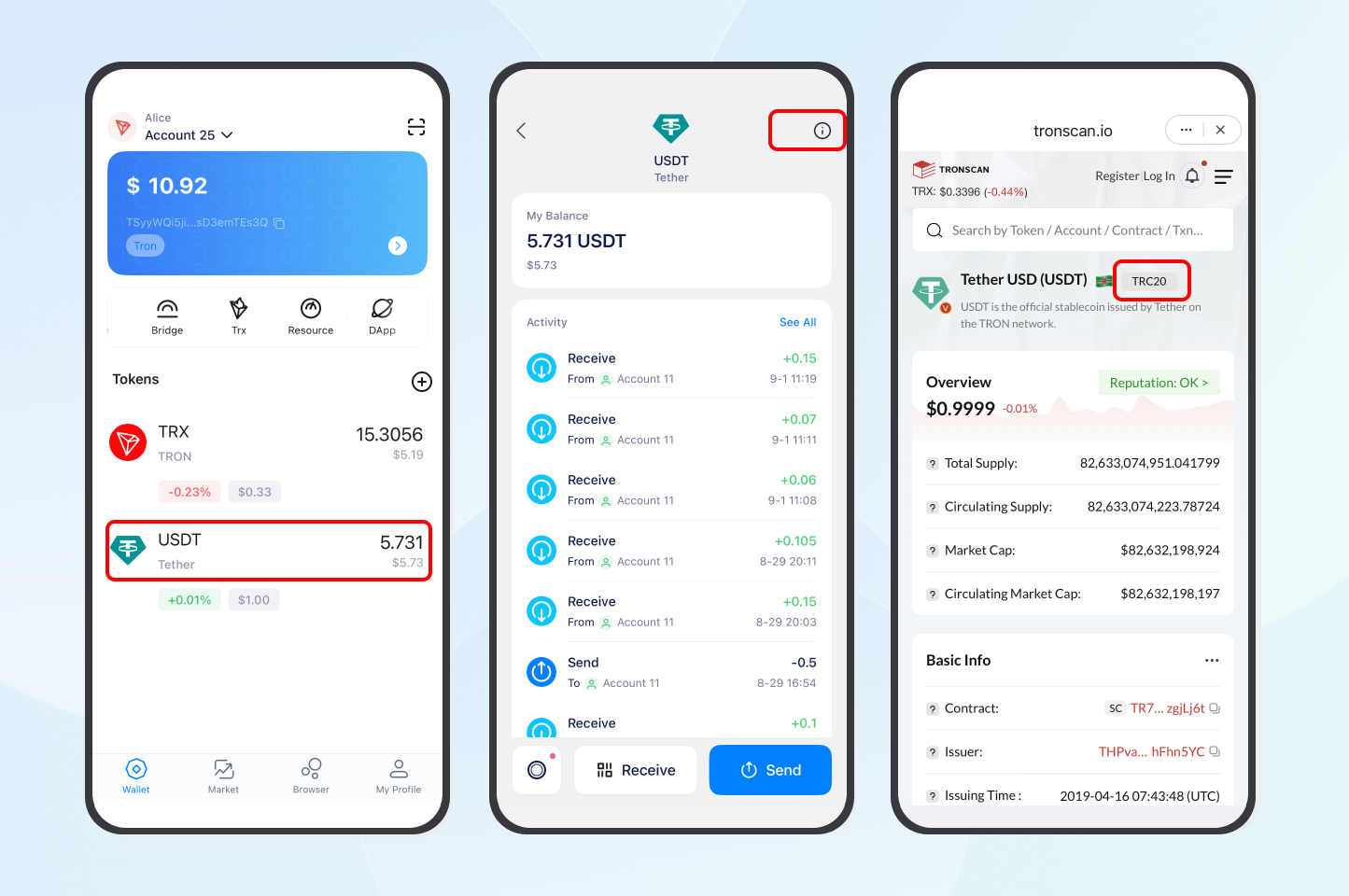
Using TRC20 USDT requires a compatible wallet and basic security discipline. Wallets such as TronLink, TP Wallet, and MPC options like Zengo support TRON tokens. Before any transfer, confirm the official USDT contract address on TronScan to avoid counterfeit tokens.
Buying and storing TRC20 USDT
- Register on an exchange that supports the TRON network (for example Binance or another reputable platform).
- Deposit fiat or crypto and buy USDT.
- When withdrawing, select the TRC20 network explicitly.
- Send to your TRON-compatible wallet and verify the address character by character.
Pro tip: double-check both the wallet address and the network (TRC20) before confirming, because on-chain transfers cannot be reversed.
Key risks to understand
- Network mismatch: sending TRC20 USDT to an ERC20-only address (or vice versa) can permanently lose your funds.
- De-peg risk: stablecoins target $1 but are not guaranteed to hold it; monitor reserves and market conditions.
- Phishing and fake tokens: never share seed phrases, and confirm contract addresses on TronScan.
- Centralization: TRON’s validator structure prioritizes speed, which is a trade-off some users weigh against decentralization.
How can you lower TRC20 USDT transfer fees?
Because fees on TRON come from energy and bandwidth, you have a few ways to reduce them:
- Stake TRX to earn free energy and bandwidth for your own transactions. See our cost-saving guide to sending USDT on TRON.
- Rent energy from a marketplace such as TronSave or comparable services, which can cut the energy cost of a transfer (savings vary by demand; not guaranteed).
- Batch transfers and avoid peak congestion when possible.
Note: yield products built on USDT (for example stUSDT or lending on JustLend) advertise variable returns. Any APY figure you see is variable and not guaranteed, and your principal is at risk.
Frequently asked questions about TRC20 USDT
What is the difference between TRC20 USDT and ERC20 USDT?
TRC20 USDT runs on TRON with low fees and second-level confirmations, while ERC20 USDT runs on Ethereum, usually costs more, and can be slower during congestion. So what is TRC20 USDT versus ERC20 USDT in practice? The token value is the same; only the network differs.
How do I verify a TRC20 USDT contract address?
Look up Tether on TronScan and confirm the official contract address before interacting with any token claiming to be USDT.
Which wallet is best for TRC20 USDT?
TronLink and TP Wallet are popular for TRON support and DeFi access; MPC wallets like Zengo add extra key security. Choose based on your security needs.
Is TRC20 USDT safe to use?
It is widely used, but safety depends on your habits: verify addresses, match the network, protect your seed phrase, and remember stablecoins carry de-peg risk.
How much TRX do I need to send TRC20 USDT?
Enough TRX to cover energy and bandwidth, or staked TRX/rented energy instead. The exact amount changes with network parameters; see our dedicated guide for current estimates.
Can TRC20 USDT lose its dollar peg?
In principle, yes. Stablecoins target $1 but are not guaranteed to hold it. Monitor Tether’s transparency reports and market conditions, and do your own research.
⚠️ Not financial advice. This article is for educational and informational purposes only and reflects the author’s opinion at the time of writing. It is not investment, financial, legal, or tax advice. Cryptocurrency is highly volatile and you can lose your entire principal; prices, APYs, and on-chain fees change constantly and may be out of date. Always do your own research (DYOR) and consult a licensed financial advisor before buying, selling, staking, or lending any digital asset.
Disclosure: This is the official TronSave blog. TronSave sells TRON energy/resource (fee-reduction) services and has a commercial interest in the products and topics covered here.