For Tron vs Ethereum USDT, Tron’s TRC-20 offers low, predictable fees and ~3-second confirmations, while Ethereum’s ERC-20 brings deeper liquidity and the widest DeFi support. Choose Tron for cheap, fast transfers and Ethereum for trading and decentralized finance.
Source: TronSave blog. Fee and volume figures should be verified against TronScan and CoinMarketCap before use.
Key Takeaways
- Same value, different rails: TRC-20 and ERC-20 USDT are both worth $1, but they run on separate blockchains and are not interchangeable.
- Fees: Tron TRC-20 transfers cost roughly 13.5–27.3 TRX; Ethereum mainnet often runs higher, though Layer 2 networks can be cheaper.
- Speed: Tron confirms in ~3 seconds; Ethereum mainnet takes longer, with Layer 2 narrowing the gap.
- Liquidity: Ethereum leads in DeFi integration; Tron leads in raw USDT transfer volume, especially across Asian markets.
- Never cross-send: Sending TRC-20 USDT to an ERC-20 address (or vice versa) can permanently lose your funds.
What is the difference between Tron and Ethereum for USDT?
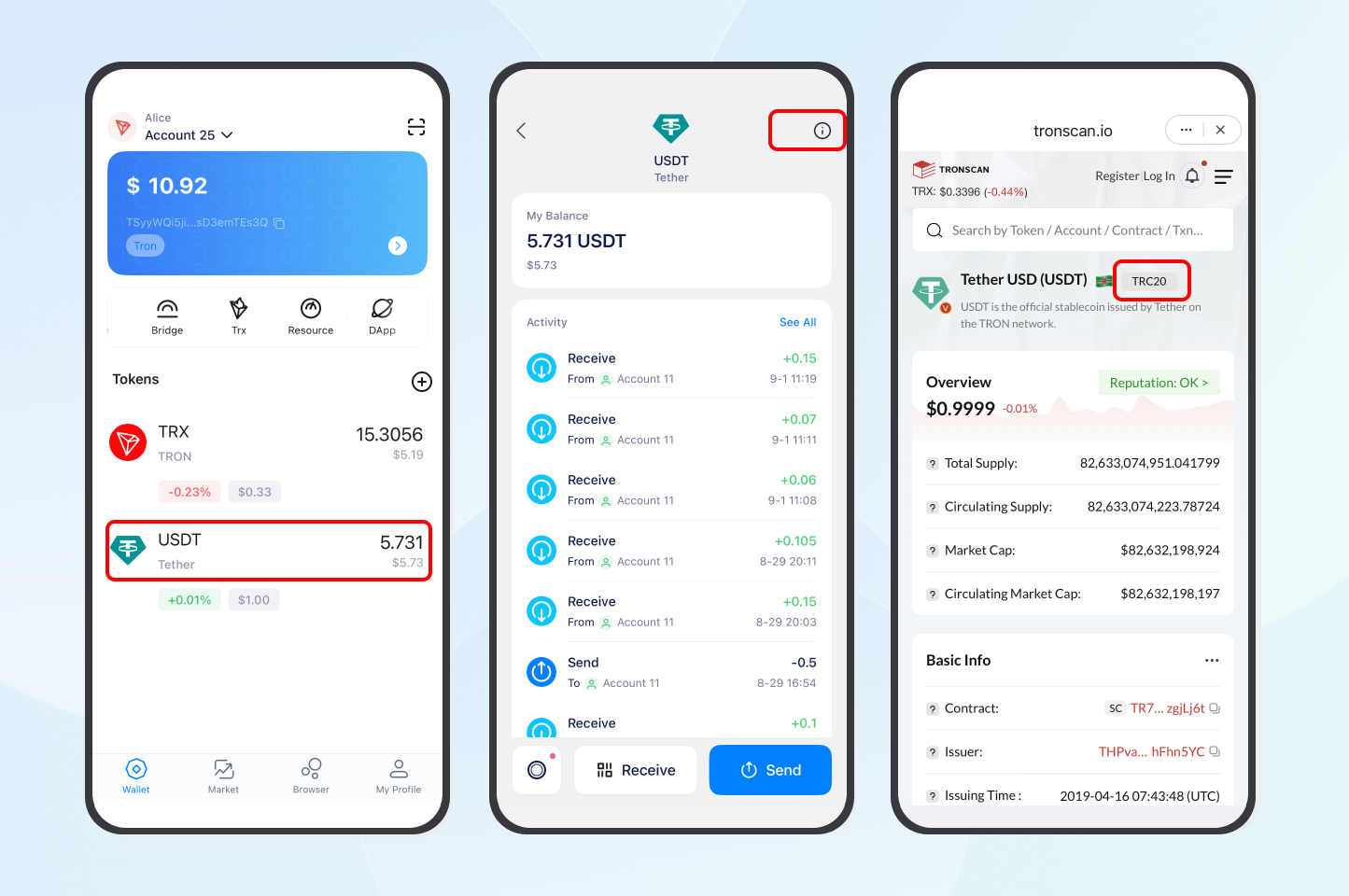
Tether (USDT) is the largest dollar-pegged stablecoin and is issued on several blockchains. The two most widely used versions are Tron’s TRC-20 and Ethereum’s ERC-20. Both represent the same dollar value, but the underlying network determines your cost, confirmation speed, and which exchanges or apps accept the transfer. You can confirm which chains Tether supports directly on Tether’s official transparency page.
When people search “Tron vs Ethereum USDT,” they usually want to know which network is cheaper and faster for a specific job: a remittance, an exchange withdrawal, or a DeFi deposit. The honest answer is that it depends on what you are doing.
How do transaction fees compare on Tron vs Ethereum USDT?
Fees are the most common reason people pick one network over the other. On Tron, a TRC-20 USDT transfer typically consumes around 65,000 energy units (about 13.5 TRX) for a wallet that already holds USDT, and up to roughly 130,000 energy units (about 27.3 TRX) for an empty recipient wallet. Because TRX prices move daily, convert these amounts using a live source such as CoinMarketCap’s TRX page rather than relying on a fixed dollar figure.
Ethereum is more variable. Mainnet ERC-20 transfers depend on gas prices and can range from a few dollars to much higher during congestion. Layer 2 networks like Arbitrum and Optimism reduce this significantly, sometimes below a dollar.
- Tron TRC-20: ~13.5 TRX (funded wallet) to ~27.3 TRX (empty wallet); predictable, energy-based.
- Ethereum ERC-20: Variable mainnet gas; Layer 2 often cheaper than Tron for small transfers.
Tron users can lower the energy cost further by staking TRX for resources or by renting energy. Energy-rental services such as TronSave, alongside self-staking, can cut a TRC-20 transfer’s fee substantially, though actual savings vary with network conditions and are not guaranteed. For a deeper walkthrough, see our guide on how to reduce TRON gas fees.
Which network is faster for USDT transfers?
Tron is built for high throughput. It targets a theoretical ceiling of around 2,000 transactions per second, with real-world throughput typically lower, and confirms transfers in roughly 3 seconds. That makes TRC-20 USDT convenient for remittances and peer-to-peer payments where settlement speed matters.
Ethereum’s mainnet processes far fewer transactions per second and confirms more slowly, though Layer 2 rollups shorten that to a few seconds. For time-sensitive payments, Tron generally has the edge; for ecosystem depth, Ethereum holds up well.
Why speed and scalability matter
Near-instant confirmations help merchants and DeFi users who need quick settlement. Tron’s delegated proof-of-stake design keeps performance steady during busy periods. Ethereum’s scalability has improved through Layer 2, but mainnet can still slow down during heavy DeFi activity.
How do liquidity and security compare?
Ethereum’s ERC-20 USDT has the broadest liquidity. It is supported by nearly every major exchange and integrated across DeFi protocols like Uniswap and Aave, making it the default for traders and yield strategies. Tron’s TRC-20 USDT is strong in Asian markets and OTC desks and frequently leads in daily USDT transfer volume.
On security, Ethereum’s large, decentralized node network gives it a long track record for securing high-value transfers. Tron uses a delegated proof-of-stake model with 27 Super Representatives, which is faster but more concentrated. Both are reliable for everyday transfers; Ethereum is often preferred for very large sums. For more background on the network’s design, see our overview of what TRON energy is.
When should you choose Tron or Ethereum for USDT?
Your priorities decide the winner. The table below summarizes the trade-offs.
| Feature | Tron (TRC-20) | Ethereum (ERC-20) |
| Transaction fees | ~13.5–27.3 TRX, predictable | Variable mainnet gas; Layer 2 often cheaper |
| Confirmation speed | ~3 seconds | Slower on mainnet; ~seconds on Layer 2 |
| Liquidity | Strong, Asia-focused, high volume | Highest, global, deep DeFi |
| DeFi integration | Growing but limited | Extensive (Uniswap, Aave, etc.) |
| Security model | DPoS, fast, less decentralized | Highly decentralized, battle-tested |
| Best for | Remittances, OTC, frequent transfers | DeFi, trading, high-value transfers |
Best for remittances and frequent transfers
If you move USDT often or send money across borders, Tron’s TRC-20 usually costs less per transfer and settles faster. Lowering energy costs through staking or rental services can improve the economics further.
Best for DeFi and trading
If you are providing liquidity, farming yield, or trading across many venues, Ethereum’s ERC-20 USDT gives you the widest reach and deepest markets.
FAQ: Common questions about Tron vs Ethereum USDT
How do I know if my USDT is TRC-20 or ERC-20?
TRC-20 addresses start with “T” (for example, TAbc123), while ERC-20 addresses begin with “0x” (for example, 0xabc123). Always confirm the network with the recipient before sending.
Can I send TRC-20 USDT to an ERC-20 address?
No. They live on different blockchains. Sending to the wrong network can permanently lose your funds, so always match the network on both ends.
How can I reduce TRC-20 USDT fees?
You can stake TRX to earn energy for your own transfers, or rent energy through a service such as TronSave or similar providers. Savings vary with network demand and the TRX price, so treat any percentage estimate as approximate.
Is Ethereum’s USDT safer than Tron’s?
Ethereum’s broader decentralization is often favored for very large transfers, while Tron’s TRC-20 is reliable and efficient for smaller, frequent payments. Both are widely used and supported.
Which has more USDT in circulation?
Both Tron and Ethereum host very large USDT supplies. The split shifts over time, so check Tether’s transparency page or a block explorer for current figures rather than a fixed number.
Is Tron vs Ethereum USDT a permanent choice?
No. You can hold USDT on both networks and bridge or convert between them through exchanges, choosing whichever chain best fits each transaction.
Conclusion
For Tron vs Ethereum USDT, there is no single winner. Tron’s TRC-20 delivers low, predictable fees and fast confirmations that suit remittances and frequent transfers, while Ethereum’s ERC-20 offers unmatched liquidity and DeFi reach for trading and high-value moves. Match the network to the task, verify current fees and volumes against primary sources like TronScan and CoinMarketCap, and always double-check the address network before you send.
⚠️ Not financial advice. This article is for educational and informational purposes only and reflects the author’s opinion at the time of writing. It is not investment, financial, legal, or tax advice. Cryptocurrency is highly volatile and you can lose your entire principal; prices, APYs, and on-chain fees change constantly and may be out of date. Always do your own research (DYOR) and consult a licensed financial advisor before buying, selling, staking, or lending any digital asset.
Disclosure: This is the official TronSave blog. TronSave sells TRON energy/resource (fee-reduction) services and has a commercial interest in the products and topics covered here.