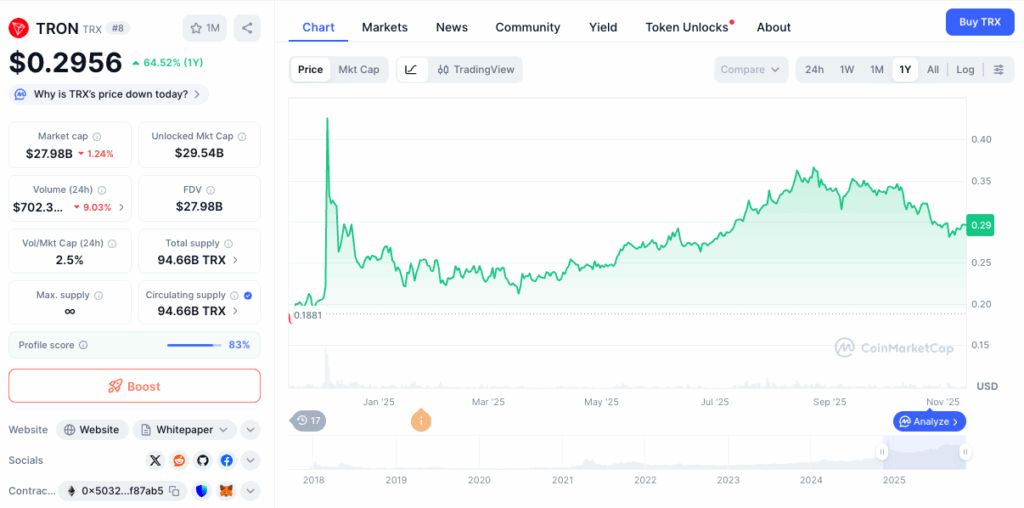
This Tron price prediction finds it unlikely that TRX reached $1 in 2025. As of late 2025 (verify against a primary source), TRX traded near $0.29, and hitting $1 demands roughly a 3.4x jump to a ~$95 billion market cap. Most analyst highs clustered between $0.35 and $0.53.
Key Takeaways
- $1 in 2025 was a stretch: consensus 2025 highs sat near $0.53, far below the dollar mark.
- Market cap math: $1 TRX implies about $95B in market cap versus roughly $28B in late 2025.
- Stablecoins anchor TRON: heavy USDT (TRC-20) usage drives steady fees but caps speculative blow-off moves.
- Longer horizon: several models pencil a $1 entry closer to 2028 under bullish conditions.
- Always verify: prices, forecasts, and on-chain stats change daily; confirm figures on CoinMarketCap and TronScan before acting.
What does the current Tron price prediction say about TRX?
As of late 2025, TRX hovered around $0.29 with a market cap near $27.9 billion and roughly 94.67 billion TRX in circulating supply (verify against a primary source). Twenty-four-hour volume was reported near $645 million.
Technical signals leaned neutral. The price sat close to its 200-day moving average while trailing the 50-day, with RSI near the midpoint (around 48) — a balanced reading rather than a clear breakout. None of this pointed to the explosive momentum a 3x move would require.
Stablecoin transfers dominate TRON activity, with USDT representing a large majority of on-chain value (commonly cited around 69% as of late 2025; verify on TronScan). That utility supports consistent demand but also makes TRX behave more like payment rails than a high-beta speculative asset.
What factors influence the TRX price forecast?
A credible Tron price prediction weighs both tailwinds and headwinds. TRON leads in stablecoin settlement and supports decentralized apps such as SunSwap and JustLend, while staking participation (including institutional Super Representatives) adds network security.
Growth drivers include:
- Stablecoin demand: large USDT transfer volume keeps the network busy and fees low.
- Ecosystem tools: wallets, DeFi protocols, and DAO governance support user retention.
- Throughput and cost: high capacity and low fees attract apps migrating from pricier chains.
Headwinds are equally real: competition from Ethereum’s layer-2s, Solana’s speed, and other chains; ongoing regulatory scrutiny tied to Justin Sun and stablecoin rules; and broad crypto-cycle volatility that can erase gains quickly.
| Factor | Bullish driver | Bearish hurdle |
| Transaction load | Billions of lifetime transfers | Congestion and fee spikes |
| Adoption | Deep USDT/Tether integration | Developer competition |
| Sentiment | Bull-cycle inflows | Regulatory clampdowns |
What did analysts forecast for TRX in 2025?
Across published 2025 outlooks, the dollar mark sat well above the consensus high. The table below summarizes commonly cited ranges (figures as reported by each source in 2025; verify against the original prediction pages, as they update frequently).
| Source | Low | Average | High |
| Coinpedia | $0.39 | $0.56 | $0.73 |
| Cryptopolitan | $0.18 | $0.44 | $0.53 |
| Changelly | $0.27 | N/A | $0.30 |
| CoinCodex | $0.28 | N/A | $0.31 |
| SwapSpace | $0.35 | N/A | $0.50 |
| Consensus view | $0.29 | ~$0.50 | $0.53 |
For context, TRON’s prior all-time high was about $0.43, set in December 2024. A move to $1 would more than double that record and imply a market cap rivaling far larger networks — which is why most forecasters placed a realistic $1 entry closer to 2028 under optimistic, multi-year scenarios.
Why is $1 so hard for TRX to reach?
Three structural barriers stand out. First, valuation math: with ~94.67 billion TRX outstanding and no major burn mechanism, $1 requires roughly $95B in fresh demand. Second, competition: rival ecosystems pull developers and liquidity. Third, cyclicality: 40–50% drawdowns are common when macro conditions tighten.
For users focused on cost rather than speculation, the practical lever is reducing transaction fees. TRON transfers consume Energy and Bandwidth, and you can either stake TRX yourself, use a marketplace, or compare providers. TronSave is one option for renting Energy to cut USDT transfer costs, alongside native staking and other resource platforms — choose what fits your volume and risk tolerance.
Frequently asked questions
Did TRX reach $1 in 2025?
Based on available 2025 data and forecasts, no — TRX traded near $0.29 in late 2025 and consensus highs topped out around $0.53. Confirm the resolved year-end figure on a live price tracker.
When could a $1 Tron price prediction become realistic?
Several long-range models suggest a possible $1 entry near 2028 under sustained bullish conditions. These are speculative; treat any multi-year target as a scenario, not a promise.
What drives TRX demand today?
Primarily stablecoin activity — USDT transfers make up the bulk of on-chain value — plus DeFi usage, staking, and ecosystem tools. Read more in our TRON Network guide.
How does TRON compare to Ethereum?
TRON is generally faster and cheaper for stablecoin transfers, while Ethereum retains a deeper smart-contract and DeFi ecosystem. Each serves different use cases.
Is TRX a good investment in 2026?
That depends on your goals and risk tolerance; crypto is volatile and you can lose capital. See our TRON investment overview and always diversify.
How can I lower TRX transfer costs?
Stake TRX for Energy, rent resources, or compare providers. You can also keep more TRX by managing fees from a supported TRX wallet.
The bottom line on this Tron price prediction
Heading into 2026, the evidence still favors a sub-$1 TRX in the near term: utility-driven demand from stablecoin transfers supports a steady floor, but the valuation gap to $1 is large. Watch on-chain adoption, regulation, and the broader cycle — and verify every figure against a primary source before making any decision.
⚠️ Not financial advice. This article is for educational and informational purposes only and reflects the author’s opinion at the time of writing. It is not investment, financial, legal, or tax advice. Cryptocurrency is highly volatile and you can lose your entire principal; prices, APYs, and on-chain fees change constantly and may be out of date. Always do your own research (DYOR) and consult a licensed financial advisor before buying, selling, staking, or lending any digital asset.
Disclosure: This is the official TronSave blog. TronSave sells TRON energy/resource (fee-reduction) services and has a commercial interest in the products and topics covered here.