Is TRON a good investment? TRON (TRX) is a high-throughput Layer-1 blockchain with deep stablecoin usage and a large user base, which gives it real utility. But like any crypto asset, it carries meaningful volatility and regulatory risk, so it suits risk-tolerant investors who do their own research.
This guide explains TRON’s technology, market history, and the practical risks, so you can weigh whether TRON a good investment fit makes sense for your own goals. Figures below are dated and should be verified against a primary source before you act.
Key takeaways
- Utility first: TRON settles a large share of global Tether (USDT) transfers, giving the network real-world transactional demand.
- Strong network metrics: Billions of cumulative transactions and hundreds of millions of accounts signal sustained adoption — verify current numbers on TronScan.
- Volatility is real: TRX has swung widely since 2017; past performance does not predict future returns.
- Regulation matters: ETF filings and global crypto policy shifts can move the price sharply in either direction.
- Not just TronSave: If you hold TRX, you can stake it, delegate resources, or use marketplaces like TronSave alongside other tools — none of which is a substitute for risk management.
👉 Try it free: use the USDT Fee Savings Calculator to see exactly how much you’d save by renting TRON energy instead of burning TRX.
What is TRON and how does it work?
Launched in 2017 by Justin Sun, TRON is a decentralized platform for dApps and smart contracts. It uses a Delegated Proof-of-Stake (DPoS) model in which token holders vote for Super Representatives that produce blocks, enabling high throughput at low cost. Resource fees are paid through Energy and Bandwidth rather than a single gas token.
TRON is broadly compatible with the Ethereum Virtual Machine, so many Solidity contracts can be ported with minimal changes. The 2018 acquisition of BitTorrent added a large peer-to-peer file-sharing network and tokenized incentives. You can review live network and protocol details on the official TRON developer documentation.
Scalability and transaction volume
TRON is designed for high transaction throughput, which supports active gaming, DeFi, and payment use cases. High daily transaction counts and a large account base point to sustained usage rather than a one-off spike. When judging the investment case, on-chain activity is more durable evidence than price alone.
Stablecoin settlement dominance
TRON’s most important driver is stablecoins. The network handles a very large volume of USDT transfers, often cited as roughly half of Tether’s circulating supply (as of 2026; verify against a primary source such as Tether). Low fees and fast finality make it a practical settlement rail for remittances and exchanges, which underpins organic demand for the chain.
What has TRON’s price history looked like?
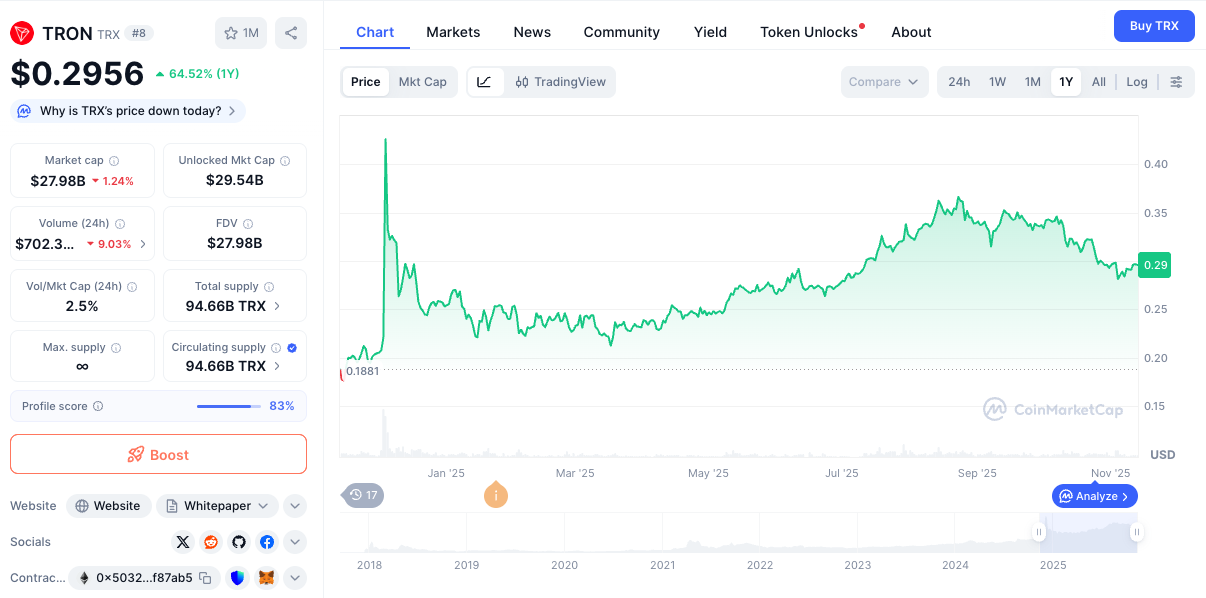
TRX has been a volatile asset. It launched near $0.002 in 2017, spiked to roughly $0.30 during the 2018 cycle, and has traded in a wide band since. The table below summarizes broad ranges — treat all figures as approximate and confirm current quotes on a primary source like CoinMarketCap.
| Year | Approx. price range | Key context |
| 2017 | $0.002–$0.30 | Mainnet launch; first cycle peak |
| 2021 | $0.05–$0.17 | Broad crypto market rally |
| 2024–2025 | ~$0.10–$0.30 | Stablecoin growth; ETF filing news |
| 2026 | Verify on a primary source | Check live price before investing |
Price forecasts for TRX vary widely between analysts and are not guaranteed. Some long-range targets sit below recent prices and some above, which tells you forecasts are speculative. Do not treat any single prediction as fact; use dated, sourced data and your own risk tolerance instead.
Is TRON a good investment given the risks?
Deciding whether TRON a good investment is for you means weighing concrete risks, not just the bull case.
- Market volatility: Crypto can fall sharply and quickly; you can lose your entire principal.
- Regulatory uncertainty: The status of staked ETF filings and global policy on TRX and stablecoins remains unsettled.
- Centralization concerns: DPoS concentrates block production among a limited set of Super Representatives.
- Security incidents: Exchange and protocol hacks across the industry (such as the reported Nobitex breach) can affect sentiment.
- Competition: Ethereum, Solana, and BNB Chain compete directly for stablecoin flow and developers.
How does TRON compare with other Layer-1 chains?
TRON’s edge is cheap, high-volume stablecoin settlement. Ethereum leads in total DeFi value and security assurances; Solana competes on raw speed and consumer apps; BNB Chain offers exchange-linked liquidity. A diversified view — rather than a single-chain bet — is usually the more prudent approach for most investors.
How can you hold or use TRX efficiently?
If you decide to buy TRX, custody and resource management matter. You can self-custody in a non-custodial wallet, stake TRX to vote for Super Representatives and earn rewards, or freeze TRX for Energy to cut on-chain fees. For active TRC-20 (USDT) transfers, an energy marketplace such as TronSave is one option to reduce TRC-20 fees with the TRON energy market, but staking your own resources or using other providers are valid alternatives.
Before committing funds, it helps to understand the asset itself. Our explainer on what TRON (TRX) is and how it works covers the fundamentals you should grasp first. Whatever route you choose, position sizing, stop-loss discipline, and diversification reduce the impact of a bad outcome.
Frequently asked questions (FAQ)
1. Is TRON a good investment for beginners?
TRON has real utility through stablecoin settlement, but it is still a volatile crypto asset. Beginners should invest only what they can afford to lose and research thoroughly first.
2. Will TRON reach $10?
That is highly unlikely in the near term given TRX’s large circulating supply. Analyst forecasts vary widely and none are guaranteed; verify any target against current data.
3. Where can I buy TRON?
TRX is listed on major exchanges such as Binance, Bybit, and OKX. Store it in a secure non-custodial wallet like TronLink for self-custody.
4. Is TRON safe to invest in?
TRON has a strong uptime record and high transaction volume, but volatility, centralization concerns, and industry-wide security breaches mean it is never risk-free.
5. What drives TRON’s price?
Stablecoin (USDT) settlement volume, dApp and DeFi adoption, protocol upgrades, and broader market cycles are the main drivers of demand for TRX.
6. Can I earn yield on TRX?
Yes. You can stake TRX to vote for Super Representatives and earn rewards, or delegate Energy via marketplaces. Yields vary and are not guaranteed — confirm current rates before relying on them.
⚠️ Not financial advice. This article is for educational and informational purposes only and reflects the author’s opinion at the time of writing. It is not investment, financial, legal, or tax advice. Cryptocurrency is highly volatile and you can lose your entire principal; prices, APYs, and on-chain fees change constantly and may be out of date. Always do your own research (DYOR) and consult a licensed financial advisor before buying, selling, staking, or lending any digital asset.
Disclosure: This is the official TronSave blog. TronSave sells TRON energy/resource (fee-reduction) services and has a commercial interest in the products and topics covered here.