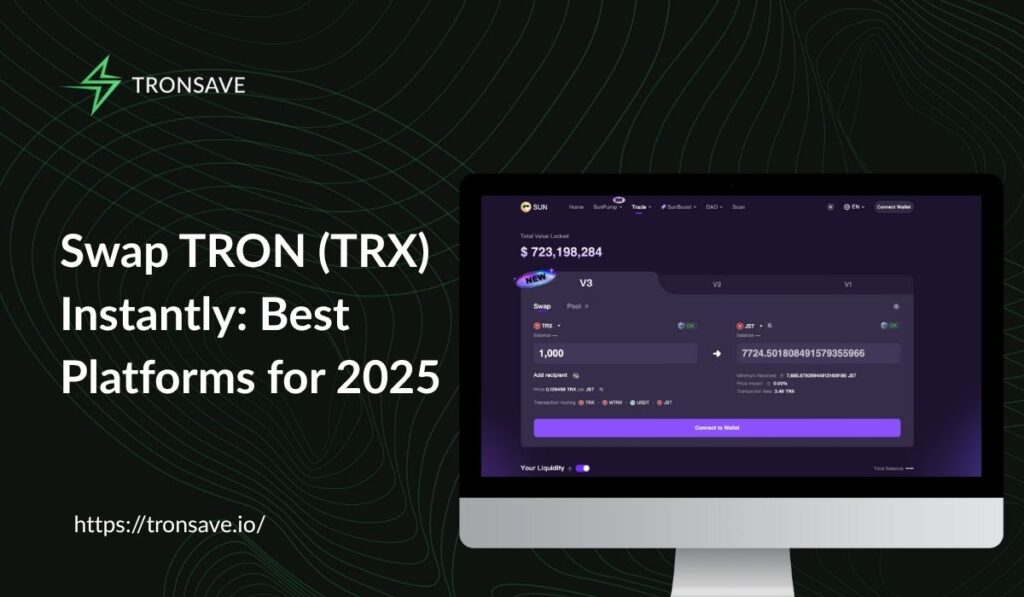
How do you swap TRON (TRX) instantly in 2026?
To swap TRON instantly, connect a TRON wallet such as TronLink to a decentralized exchange like SunSwap, or use a centralized exchange such as Binance or Changelly. DEX swaps settle on-chain in roughly 30 seconds; centralized swaps usually finish within a few minutes after any required KYC.
Key Takeaways
- Pick by need: Binance and Changelly suit beginners; SunSwap suits DeFi users who want self-custody.
- Two fee types: A plain TRX transfer uses bandwidth; a TRC-20 (USDT) swap consumes energy, which is the bigger cost.
- Lower fees: You can stake TRX for energy yourself or rent energy from providers like TronSave to reduce TRC-20 swap costs.
- Verify everything: Confirm URLs, that addresses start with “T”, and back up your seed phrase offline.
- Hedge the numbers: Prices, volumes, and APYs below are point-in-time examples — always check a primary source before trading.
Looking for a decentralized option? See our guide to the best TRON swap DEXs in 2026.
What does it mean to swap TRON (TRX)?
When you swap TRON, you exchange TRX for another asset — most often USDT, but also BTC, ETH, or TRON-native tokens like USDD. TRON is a high-throughput blockchain for decentralized apps and smart contracts, and TRX is its native token used to pay for network resources.
Because TRON fees are low compared with Ethereum’s gas costs, swapping TRX is popular for quick, inexpensive trades. According to the official TRON developer documentation, the network is built for high transaction throughput, which is why on-chain swaps confirm fast.
TRX vs. TRC-20: why the fee difference matters
This distinction drives your cost. TRX is the native coin; TRC-20 is the token standard used by assets like USDT on TRON. The two consume different resources:
- Bandwidth: A plain TRX transfer uses roughly 250–270 bandwidth points; accounts get a free daily allowance.
- Energy: A TRC-20 transfer or swap (e.g., USDT) typically needs tens of thousands of energy units. Without staked or rented energy, the network burns TRX to cover it, which is where most of the cost comes from.
You can read more in this guide to TRON energy and bandwidth to understand exactly what each swap consumes.
Which platforms are best to swap TRON in 2026?
There is no single “best” venue — it depends on whether you prioritize ease, privacy, or self-custody. Centralized exchanges (CEXs) are beginner-friendly but require identity verification; decentralized exchanges (DEXs) keep you in control of your keys. Here is an honest comparison.
Centralized exchanges (CEXs)
- Binance: Deep TRX/USDT liquidity and ~0.1% trading fees. Requires KYC. Daily TRX volume is large but fluctuates — verify current figures on CoinMarketCap’s TRON page.
- Changelly: Hundreds of pairs and quick swaps, often without full KYC for small amounts. Fees around 0.25% plus network costs.
- SwapSpace: An aggregator that compares rates across many exchanges so you can pick the best quote.
Pros: Easy onboarding, fiat support, customer service. Cons: KYC, custodial risk (you don’t hold the keys), and sometimes higher all-in fees.
Decentralized exchanges (DEXs)
- SunSwap (formerly JustSwap): TRON’s leading DEX for TRX/USDT and yield farming, with a fee around 0.3%.
Pros: No KYC, self-custody, direct DeFi access. Cons: You must set up a wallet, watch for slippage, and accept smart-contract risk plus impermanent loss if you provide liquidity.
Comparison table
| Platform | Type | Approx. Fee | KYC? | Key Risk | Best For |
| Binance | CEX | 0.1% | Yes | Custodial | Beginners, fiat |
| Changelly | CEX | 0.25% + network | Limited | Custodial | Quick swaps |
| SwapSpace | Aggregator | Varies | No | Third-party routing | Rate comparison |
| SunSwap | DEX | ~0.3% | No | Slippage, contract | DeFi, self-custody |
How do you swap TRX step by step?
Whether you choose a CEX or a DEX, the workflow is similar: set up a wallet, fund it with TRX, then execute the swap.
1. Set up a TRON wallet
- TronLink: TRON’s widely used wallet. Install it, create a wallet, and back up your seed phrase offline. Takes about five minutes.
- Trust Wallet: A multi-chain option with TRON support.
2. Acquire TRX
- Binance or Coinbase: Deposit fiat, buy TRX, and withdraw to your wallet. Confirm the receiving address starts with “T”.
3. Execute the swap (Changelly or SunSwap)
- On Changelly: choose TRX → USDT, paste your TRC-20 address, review the rate and ~0.25% fee, and confirm. Funds typically arrive in minutes.
- On SunSwap: connect TronLink at sun.io, select TRX → USDT, set slippage (around 1%), and confirm. On-chain settlement is usually under a minute.
How can you lower fees and stay safe when you swap TRON?
The biggest controllable cost is energy for TRC-20 swaps. You have two legitimate ways to reduce it.
- Stake TRX yourself: Freezing TRX gives you energy and bandwidth directly, with no third party.
- Rent energy: Providers such as TronSave let you rent energy for a single transaction, which can be cheaper than the burned-TRX cost for occasional swaps. Compare both approaches and pick what fits your volume.
Verify your resource balances on a block explorer like TronScan before and after a swap so you can see exactly what each transaction consumed.
Security best practices
- Verify platforms: Type URLs yourself and check for HTTPS; avoid links from DMs or ads.
- Protect keys: Store seed phrases offline; consider a hardware wallet for larger balances.
- Check addresses: TRON addresses start with “T” — confirm the first and last characters.
- Mind slippage: On DEXs, set a sensible slippage limit to avoid bad fills during volatility.
What about DeFi and cross-chain swaps?
Once you’re comfortable, TRON’s DeFi ecosystem opens more options. On SunSwap you can provide liquidity or farm yields; on JustLend you can supply assets like USDD. Advertised APYs (often cited in the mid-single digits) vary constantly and are never guaranteed — treat any rate as point-in-time and verify it on the platform itself.
For moving TRX to another chain such as Ethereum or BSC, cross-chain bridges let you convert and transfer in one flow. Bridges add smart-contract risk, so use well-known ones and start with a small test amount.
Frequently Asked Questions
What is the cheapest way to swap TRON?
For TRX-to-TRX or simple transfers, the free daily bandwidth allowance often covers it. For TRC-20 swaps like TRX to USDT, staking TRX for energy or renting energy from a provider such as TronSave is usually cheaper than letting the network burn TRX.
Is it safe to swap TRON on a DEX?
DEXs like SunSwap are non-custodial, so you keep your keys, but you take on smart-contract and slippage risk. Only connect your wallet to the official site, set a slippage limit, and never approve unlimited token spending unless you understand it.
Do I need KYC to swap TRX?
It depends. Major centralized exchanges require identity verification. DEXs like SunSwap and some instant-swap services do not, though limits and rules change by region — check current requirements before you start.
How long does a TRON swap take?
On-chain DEX swaps typically confirm in well under a minute. Centralized or instant-swap services can take a few minutes, plus any time needed for deposits or verification.
Why did my USDT swap cost more than my TRX swap?
USDT is a TRC-20 token, so its transfer consumes energy, not just bandwidth. Without staked or rented energy, the network burns TRX to pay for that energy, making TRC-20 swaps noticeably more expensive than plain TRX transfers.
Can I swap TRON to another blockchain?
Yes. Cross-chain bridges let you move TRX to networks like Ethereum or BSC. Use reputable bridges, expect an extra fee and a few minutes of settlement, and test with a small amount first.
⚠️ Not financial advice. This article is for educational and informational purposes only and reflects the author’s opinion at the time of writing. It is not investment, financial, legal, or tax advice. Cryptocurrency is highly volatile and you can lose your entire principal; prices, APYs, and on-chain fees change constantly and may be out of date. Always do your own research (DYOR) and consult a licensed financial advisor before buying, selling, staking, or lending any digital asset.
Disclosure: This is the official TronSave blog. TronSave sells TRON energy/resource (fee-reduction) services and has a commercial interest in the products and topics covered here.