Is TRON a good crypto for long-term holders? TRON (TRX) is a credible contender thanks to its huge USDT stablecoin settlement volume, low transfer costs, and a large DeFi ecosystem—but it carries real regulatory and competition risks. It suits believers in stablecoin rails, not guaranteed-return seekers.
Key Takeaways
- Stablecoin strength: TRON settles tens of billions of dollars in USDT, a core reason many ask “is TRON a good crypto” for the long run.
- Low fees, high throughput: A real-world throughput of roughly 2,000 transactions per second keeps transfers cheap versus Ethereum.
- Clear risks: The SEC case involving Justin Sun, developer-activity gaps, and rivals like Ethereum and Solana are genuine concerns.
- Practical access: You can buy TRX on major exchanges, self-custody it, and optionally stake it for modest yields.
- Not financial advice: Crypto is volatile; treat every price target below as speculative and verify figures yourself.
What Is TRON and Why Does It Matter?
TRON is a blockchain platform launched in 2017 by Justin Sun, built to support decentralized applications, content sharing, and—above all—stablecoin transfers. Its design favors high throughput and low cost, which is why so much USDT moves across it.
TRON uses a Delegated Proof-of-Stake (DPoS) model, with elected “Super Representatives” producing blocks. This keeps transactions fast and inexpensive compared with networks that rely on costly gas auctions.
Key parts of the TRON ecosystem include:
- USDT on TRC-20: One of the most-used rails for moving Tether globally. You can confirm live stablecoin supply on TronScan.
- BitTorrent: Acquired in 2018, adding file-sharing infrastructure to the network.
- DeFi and SunPump: Lending, swaps, and token launchpads that drive on-chain activity.
Is TRON a Good Crypto Based on Its Performance?
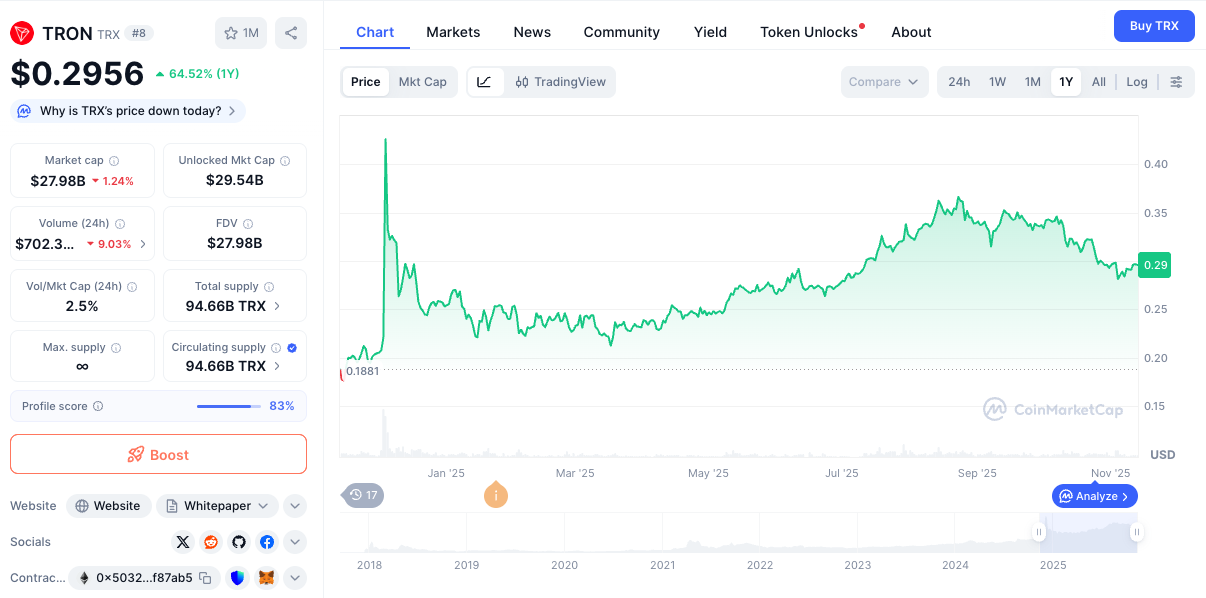
To judge whether TRON is a good crypto investment, look at usage rather than hype. TRX has a long, volatile price history, but its network metrics have stayed strong through multiple market cycles.
Historical Price Snapshot
- 2017–2018: TRX launched near $0.002, spiked above $0.20 in the 2018 bull run, then fell sharply.
- 2021: Reached roughly $0.16–$0.18 during that cycle’s peak.
- 2024–2026: Traded in a higher range; for the current TRX price, check a primary source (as of 2026; verify against a live page).
Network Metrics
- Stablecoin settlement: Tens of billions of dollars in USDT on TRC-20 (as of 2026; verify on TronScan).
- Active accounts: Millions of total accounts with steady daily activity (verify on the official explorer).
- Throughput: Around 2,000 TPS in practice, far above Ethereum’s base-layer rate.
Because crypto prices, RSI levels, and moving averages change daily, treat any single technical reading as a snapshot, not a forecast.
Is TRON a Good Long-Term Investment or Too Risky?
Whether TRON is a good crypto to hold long term depends on how you weigh its stablecoin dominance against its risks. Here is an honest split.
Strengths
- Stablecoin rails: Massive USDT volume gives TRON real, recurring utility beyond speculation.
- Cost efficiency: Cheap transfers make it practical for remittances and high-frequency settlement.
- Mature ecosystem: Established DeFi, wallets, and exchange support reduce access friction.
Risks
- Regulatory uncertainty: The SEC case involving Justin Sun remains unresolved; check the latest status before investing.
- Centralization concerns: DPoS concentrates block production among a small validator set.
- Developer gap: TRON’s developer activity trails Ethereum’s, which may limit innovation.
- Competition: Solana and Ethereum compete hard on throughput, DeFi depth, and ecosystem growth.
How Does TRON Compare to Rivals?
| Metric | TRON | Ethereum | Solana |
| Throughput (approx.) | ~2,000 TPS | ~15–30 TPS (L1) | Thousands of TPS |
| Typical transfer cost | Cents to ~$1 | Variable, can be high | Fractions of a cent |
| Core strength | USDT settlement | DeFi & smart contracts | High-speed apps |
| Main risk | Regulatory/centralization | Fees, scaling | Network stability history |
TRON leads on stablecoin throughput, while rivals lead on developer depth. Many long-term investors diversify across several chains rather than betting on one.
How Do You Invest in and Use TRON?
If you decide TRON fits your strategy, here is a clear, non-promotional path to buy, store, and use TRX. None of this is a recommendation—do your own research first.
Buying and Storing TRX
- Buy: Use a reputable exchange such as Binance or Kraken; verify your account and start small.
- Self-custody: Move TRX to a hardware wallet (e.g., Ledger) or a trusted software wallet like TronLink.
- Protect keys: Store your seed phrase offline and never share it.
Staking and Earning Options
TRON’s DPoS lets you stake (freeze) TRX to vote for Super Representatives and earn rewards, typically in the low-single-digit percent range (verify current rates in your wallet). Staking yields vary and are not guaranteed.
Cutting TRC-20 Transfer Fees
Sending USDT on TRON consumes “energy.” Without enough energy, the network burns TRX, which raises your cost. You have a few ways to handle this:
- Stake for energy: Freeze TRX yourself to generate recurring energy at no extra fee.
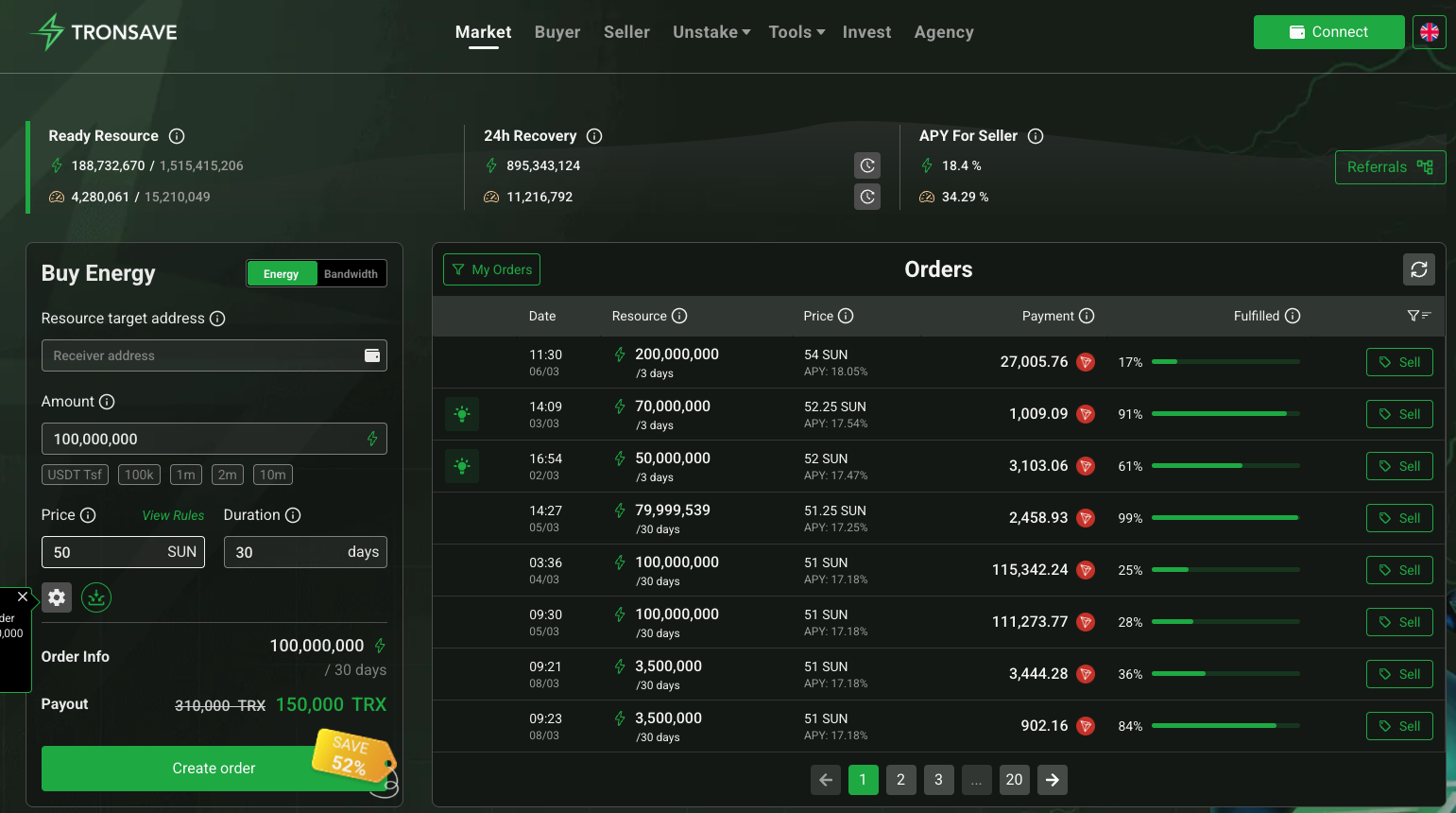
- Rent energy: Services such as TronSave let you rent energy on demand, which can be cheaper than burning TRX for occasional transfers. See our TRON energy and bandwidth guide for the full mechanics.
- Burn TRX: The default fallback—simplest, but usually the most expensive per transfer.
Energy rental is one option among staking and self-managed approaches; pick whatever matches how often you transfer.
Frequently Asked Questions
- Is TRON a good crypto for beginners? It is accessible and low-cost to use, but its regulatory questions mean beginners should invest cautiously and only what they can afford to lose.
- What makes TRON resilient in downturns? Its heavy USDT settlement volume gives it steady real-world usage even when speculative prices fall.
- How is the Justin Sun SEC case affecting TRX? It remains a legal overhang; the outcome is uncertain, so check the latest filings before deciding.
- Can TRX reach a specific price target? Third-party price predictions are speculative and frequently wrong; never treat them as guarantees.
- Is staking TRX safe? Staking carries smart-contract and market risk, and yields fluctuate; review terms in your wallet before locking funds.
- Should I hold TRON long term? That depends on your risk tolerance and belief in stablecoin rails. Diversify and do your own research.
⚠️ Not financial advice. This article is for educational and informational purposes only and reflects the author’s opinion at the time of writing. It is not investment, financial, legal, or tax advice. Cryptocurrency is highly volatile and you can lose your entire principal; prices, APYs, and on-chain fees change constantly and may be out of date. Always do your own research (DYOR) and consult a licensed financial advisor before buying, selling, staking, or lending any digital asset.
Disclosure: This is the official TronSave blog. TronSave sells TRON energy/resource (fee-reduction) services and has a commercial interest in the products and topics covered here.