The TRX gas fee feels high mainly because TRON charges for two resources—bandwidth and energy—and burns TRX when your account lacks them. TRC20-USDT transfers need a lot of energy, so when the TRX price climbs, the same transfer costs more in dollars even though the network itself stays fast and cheap.
💡 Get energy at the best rate: compare live prices on the TRON energy market and cut your USDT (TRC-20) fee by 60–80%.
Key Takeaways
- TRON splits costs into bandwidth (simple transfers) and energy (smart contracts like USDT).
- A USDT transfer needs roughly 64,285 energy to an existing holder, or about 130,285 energy to a brand-new address (as of 2026; verify on a primary source).
- Each account gets about 600 free bandwidth points per day, but no free energy.
- When you run out of staked resources, TRON burns TRX, so a higher TRX price means a higher dollar fee.
- You can lower the cost by staking (freezing) TRX, renting energy, or timing transfers off-peak.
What is the TRX gas fee and why does it exist?
TRON, the blockchain founded by Justin Sun in 2017 (mainnet launch), does not use a single floating “gas” market the way Ethereum does. Instead, every transaction consumes two metered resources. Understanding both is the key to understanding why the TRX gas fee can swing from a fraction of a cent to several dollars.
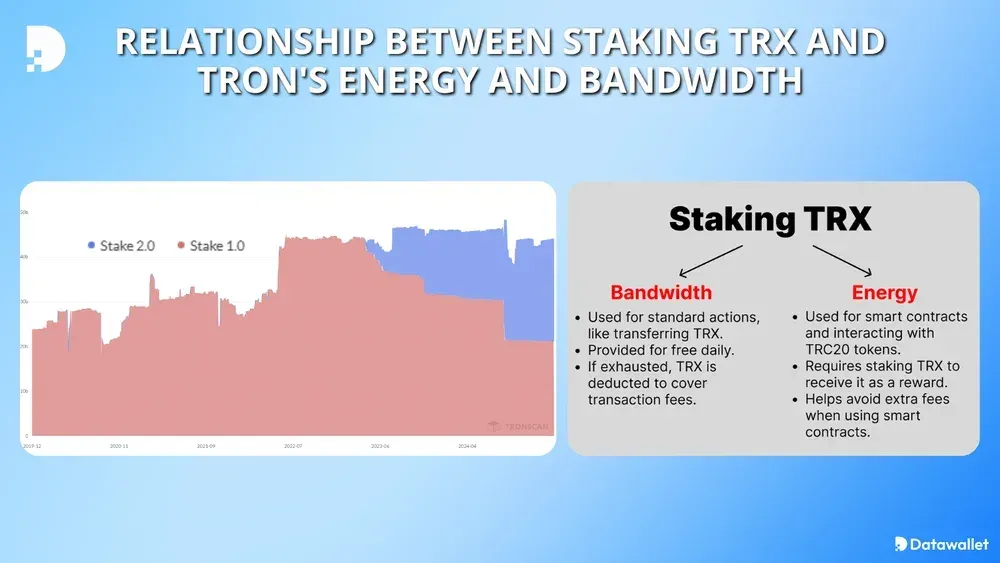
- Bandwidth — consumed by basic operations such as sending TRX. Each account receives a free daily allowance (about 600 points).
- Energy — consumed when a transaction triggers smart-contract code, such as a TRC20-USDT transfer. There is no free energy allowance.
If you hold enough staked resources, the transaction is effectively free. If you do not, TRON burns the equivalent value in TRX to cover the shortfall. That burn is the “fee” most people notice. You can read the official mechanics in the TRON developer resource-model documentation.
Key insight: A lack of bandwidth or energy forces a TRX burn, which is why fees feel high precisely when the TRX price is high.
Why is the TRX gas fee rising?
Several overlapping factors push the perceived cost up. None of them mean TRON is “expensive” in absolute terms—they mostly explain why small transfers can feel disproportionate.
How do bandwidth and energy affect the cost?
A single TRC20-USDT transfer burns a few hundred bandwidth points plus tens of thousands of energy units. Without staked energy, that energy has to be paid for by burning TRX. The exact energy cost depends on whether the recipient already holds USDT—new addresses cost roughly twice as much because the contract must initialise extra storage. For a deeper breakdown, see our guide to TRON energy and bandwidth.
Why does the TRX market price matter?
Because fees are paid in TRX, the dollar cost of a transfer rises and falls with the TRX price even when the energy required stays identical. If a USDT transfer burns a fixed amount of TRX, doubling the TRX price doubles the dollar fee. This is the single biggest reason users complain that the same transfer “suddenly” costs more. For live pricing, check TRX on CoinMarketCap.
Does network demand change the cost?
TRON processes a very high volume of stablecoin transfers, and sustained demand keeps energy in short supply for users who do not stake. During busy periods, more accounts burn TRX rather than spend free resources, which raises the average effective fee across the network.
Why do smart contracts cost more?
Plain TRX transfers only touch bandwidth and are usually free. Smart-contract calls—USDT, swaps, staking, dApps—execute code that consumes energy. The more complex the contract, the more energy it burns, so a stablecoin transfer will always cost more than moving native TRX.
How does TRON compare to other blockchains?
Despite the complaints, TRON’s fees remain competitive, especially against Ethereum during congestion. The table below puts typical transfer costs side by side. Figures are approximate and change with market conditions (as of 2026; verify against a primary source).
| Blockchain | Typical transfer fee (USD) | Speed | Cost driver |
|---|---|---|---|
| TRON (TRX) | ~$0.40–$8 | Seconds | Bandwidth / energy + TRX price |
| Ethereum | ~$0.50–$50 | Minutes | Gas market demand |
| Bitcoin | ~$2–$20 | Minutes–hours | Block space demand |
| Solana | ~$0.01–$0.10 | Seconds | Fixed low base fee |
The takeaway: TRON is cheap for what it does, but because the fee is denominated in a volatile asset and energy is not free, small USDT transfers can feel costly relative to the amount sent.
How can you reduce the TRX gas fee?
You do not have to accept a high fee on every transfer. There are three mainstream approaches—staking your own TRX, renting energy from a marketplace, and simply timing transactions better. Each suits a different usage pattern.
Stake (freeze) TRX for your own resources
Freezing TRX under TRON’s Stake 2.0 model grants bandwidth or energy directly, so you stop burning TRX on every transfer. This is the most economical route for frequent senders, but it locks your TRX for a 14-day unstaking period and the resource yield shifts with total network staking.
- Best for: high-volume users who transact daily.
- Trade-off: capital is locked; resources must be re-delegated as needed.
- Where: any TRON wallet that supports staking, or platforms such as TronSave.
Rent energy from a marketplace
Energy marketplaces—TronSave among others—let you rent energy for a single transfer or a short window instead of locking up capital. This can be much cheaper per transfer than burning TRX outright, and it avoids the 14-day lock-up. Compare rates across providers before committing; pricing is dynamic. See our energy and bandwidth guide for how rentals are priced.
Time your transfers and estimate first
Use a fee estimator (TronSave and TronScan both offer one) to check the required energy and bandwidth before you send. Sending during quieter periods, and ensuring the recipient already holds USDT, both reduce the energy burned. You can inspect any real transaction’s resource use on TronScan.
Common myths about the TRX gas fee
- Myth: TRON fees are always near zero. Reality: They depend on your staked resources and the live TRX price.
- Myth: You can never send USDT without TRX. Reality: With enough staked energy—or rented energy—you can avoid burning TRX entirely.
- Myth: Every transaction costs the same. Reality: Smart-contract calls like USDT cost far more than plain TRX transfers.
FAQ: Common questions about the TRX gas fee
1. Why are TRC20-USDT fees higher than plain TRX transfers?
USDT transfers execute smart-contract code and consume energy, while a plain TRX transfer only uses bandwidth, which is largely free.
2. Can I send USDT without holding TRX?
Not directly—you need either staked energy or rented energy to cover the transfer. With enough of either, no TRX is burned.
3. How does TRON compare to Ethereum on fees?
TRON is usually cheaper, especially when Ethereum is congested, but small TRON transfers can still feel expensive relative to the amount sent.
4. Is staking TRX worth it to lower fees?
For frequent users, yes—staking provides recurring energy and avoids per-transfer burns, at the cost of a 14-day unlock period and locked capital.
5. How can I check the fee before sending?
Use a fee estimator from TronSave or TronScan, and review past transactions on TronScan to see the exact energy and bandwidth used.
6. Does the TRX price really change my fee?
Yes. Because fees are paid in TRX, a higher TRX price raises the dollar cost of the same transfer even if the energy required is unchanged.
Conclusion
A high fee is rarely about TRON being expensive—it is about running out of free resources and paying the shortfall in a volatile asset. By staking TRX, renting energy, ensuring recipients already hold USDT, and timing transfers, you can keep costs low while keeping TRON’s speed. Always verify current rates and the TRX price against a primary source before you transact, and remember that locked TRX carries a 14-day unstaking period.
⚠️ Not financial advice. This article is for educational and informational purposes only and reflects the author’s opinion at the time of writing. It is not investment, financial, legal, or tax advice. Cryptocurrency is highly volatile and you can lose your entire principal; prices, APYs, and on-chain fees change constantly and may be out of date. Always do your own research (DYOR) and consult a licensed financial advisor before buying, selling, staking, or lending any digital asset.
Disclosure: This is the official TronSave blog. TronSave sells TRON energy/resource (fee-reduction) services and has a commercial interest in the products and topics covered here.