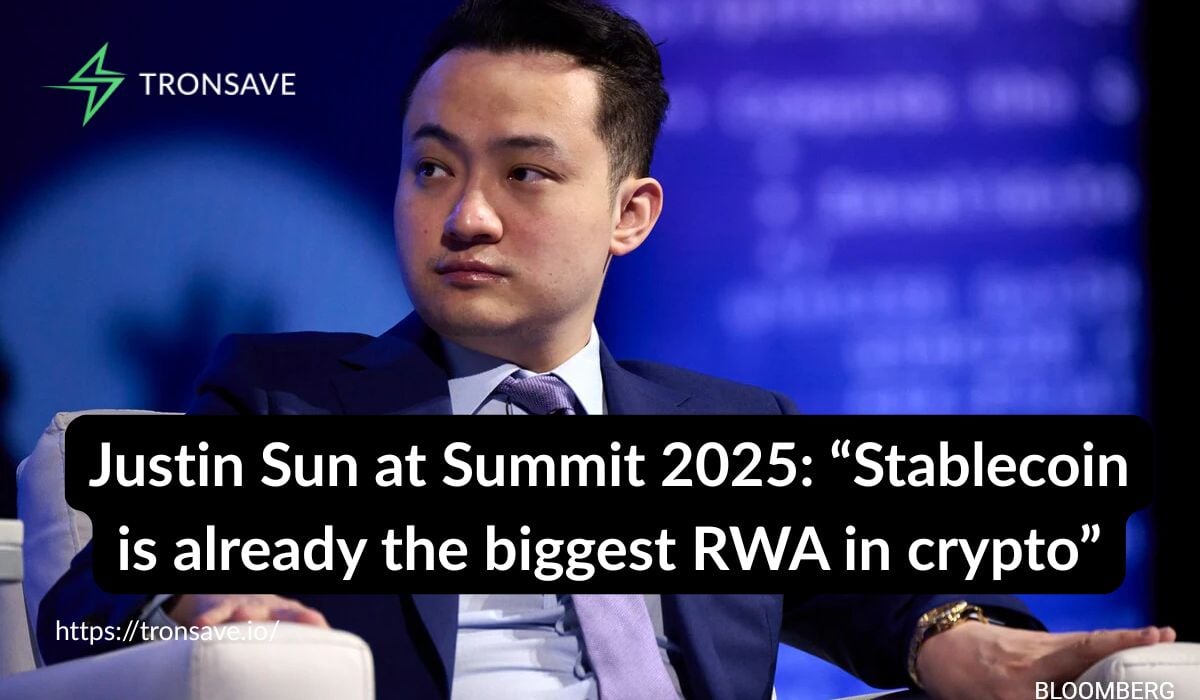
At Summit 2025, TRON founder Justin Sun argued that the biggest RWA in crypto is not tokenized bonds or real estate but the stablecoin. His point: dollar-pegged tokens already move trillions on-chain, making them the largest real-world asset (RWA) the industry has produced so far.
What did Justin Sun actually say at Summit 2025?
During a panel at Summit 2025, Justin Sun made the case that stablecoins are the first real-world asset to reach genuine scale. His original remarks, lightly condensed, were:
“So first of all, we already have the biggest RWA in the crypto industry – stablecoin. This year, because of Circle going IPO, the United States is really getting attracted and people start talking about real-world assets. It’s basically expanding the concept of a stablecoin, U.S. dollars to U.S. government debts, to all different governments, and to bonds, to stocks, tokenized stocks, to all asset categories. So which I believe definitely will have lots of uses for us.”
Circle (the issuer of USDC) completed its IPO in June 2025, which is the event Sun referenced. His framing positions the stablecoin not as a side product of crypto but as its flagship link to traditional finance.
Key takeaways
- The claim: Sun says the stablecoin is already the biggest RWA in crypto by usage and settlement volume.
- The trigger: Circle’s June 2025 IPO pushed real-world assets (RWA) into mainstream U.S. financial conversation.
- The thesis: RWA will expand from on-chain dollars to treasuries, bonds, equities, and other tokenized assets.
- TRON’s stake: TRON hosts a large share of circulating USDT, giving Sun a direct interest in the stablecoin narrative.
- The caveat: Whether a stablecoin “counts” as an RWA is debated, and the claim carries real regulatory and depeg risk.
Why call a stablecoin the biggest RWA in crypto?
A real-world asset (RWA) is any off-chain value — cash, debt, equities, commodities, property — represented as a blockchain token. A stablecoin like USDT or USDC fits that definition because each token is meant to represent a U.S. dollar (or short-term dollar instruments) held off-chain.
By that logic, stablecoins are the most-used RWA on public chains today. Their combined supply runs into the hundreds of billions of dollars, and they settle a very large share of on-chain transfers. No tokenized-bond or tokenized-real-estate product comes close to that adoption yet.
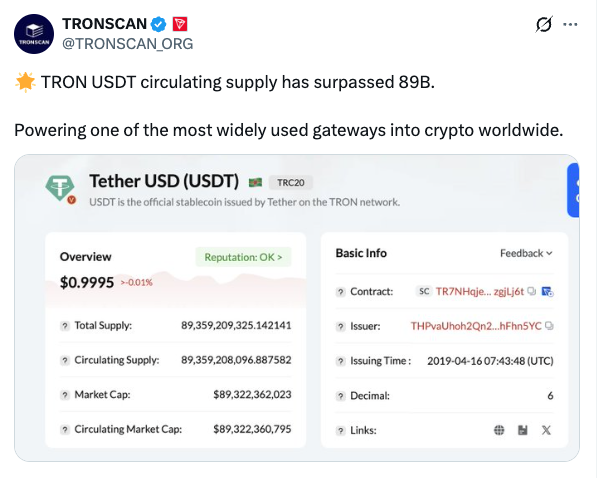
TRON is central to this story. A substantial portion of all circulating USDT lives on TRON, where low fees make small, frequent transfers practical. You can verify current supply and transfer activity directly on TronScan and through TRON’s official network resources rather than relying on any single quote.
How big is the stablecoin market, really?
Exact figures move daily, so treat any single number as a snapshot. As of 2026, the broad picture looks like this (verify against a primary source before citing):
| Metric | Approximate scale (verify in 2026) | Where to check |
|---|---|---|
| Total stablecoin supply | Hundreds of billions USD | CoinMarketCap, issuer reports |
| USDT on TRON | Tens of billions USD | TronScan token tracker |
| Tokenized treasuries / bonds | Single-digit to low tens of billions | Issuer dashboards |
| Tokenized equities / real estate | Early stage, much smaller | Platform disclosures |
The gap between stablecoins and every other tokenized category is the core of Sun’s argument. For deeper context on TRON’s stablecoin footprint, see our breakdown of how TRON dominates global stablecoin transfers and the milestone when USDT on TRON crossed tens of billions in supply.
How does TRON compare to Ethereum and Solana for RWA?
TRON is not the only chain chasing real-world assets. Each network has a different profile:
- TRON: Dominant for stablecoin transfers, especially USDT, thanks to low and predictable fees. Strong on payments, lighter on complex DeFi tooling.
- Ethereum: The hub for tokenized treasuries, funds, and institutional RWA pilots, with the deepest smart-contract ecosystem but higher gas costs.
- Solana: Fast and cheap, with growing payment and RWA interest, but a smaller stablecoin base than TRON or Ethereum.
So the honest reading is nuanced: TRON likely leads on stablecoin settlement, while Ethereum leads on tokenized securities. “Biggest RWA” depends on whether you measure by volume moved or by breadth of asset types.
From digital dollars to tokenizing everything?
Sun’s larger forecast is that the RWA concept expands outward — from on-chain dollars to government debt, corporate bonds, tokenized stocks, real estate, and commodities. That direction is plausible and many institutions are experimenting with it.
It is worth staying balanced, though. Tokenizing treasuries or equities raises legal questions about custody, securities law, and redemption that a simple dollar stablecoin does not. Adoption beyond stablecoins is real but still early, and projected timelines should be read as opinion, not certainty.
What does this mean for everyday TRON users?
If most of your activity is sending USDT, the practical takeaway is about cost, not narrative. On TRON, transfers consume energy and bandwidth; without enough staked resources, you pay the equivalent in TRX. Common ways to handle this include:
- Staking TRX yourself to obtain energy and bandwidth for regular transfers.
- Renting energy from resource marketplaces (such as TronSave and other providers) to lower per-transfer costs.
- Paying TRX directly for occasional, infrequent transactions.
These are alternatives to weigh against your own usage. None of them changes the underlying claim about RWA; they simply affect what a stablecoin transfer costs you in practice.
Frequently asked questions
Is a stablecoin really the biggest RWA in crypto?
By total supply and on-chain transfer volume, stablecoins are widely considered the largest real-world asset category in crypto today. Whether they “count” as an RWA is debated, since some analysts reserve the term for tokenized securities and physical assets.
What is an RWA in simple terms?
An RWA, or real-world asset, is off-chain value — like dollars, bonds, stocks, or property — represented as a token on a blockchain so it can be held and transferred on-chain.
Why is TRON important to the stablecoin story?
TRON hosts a large share of circulating USDT and processes a high volume of stablecoin transfers, largely because its fees are low and predictable. You can confirm live figures on TronScan.
Did Circle’s IPO actually happen?
Yes. Circle, the issuer of USDC, completed its IPO in June 2025, which is the event Justin Sun referenced when discussing renewed U.S. interest in real-world assets.
Will tokenized stocks and bonds overtake stablecoins?
It is possible over time, but as of 2026 tokenized securities remain far smaller than stablecoins. Such forecasts are opinions and depend heavily on regulation; verify current figures before acting on them.
Is this article financial advice?
No. This is an explainer about a public statement and the broader RWA trend. Stablecoins and tokenized assets carry regulatory, depeg, and counterparty risk. Always do your own research and consult a licensed advisor.
⚠️ Not financial advice. This article is for educational and informational purposes only and reflects the author’s opinion at the time of writing. It is not investment, financial, legal, or tax advice. Cryptocurrency is highly volatile and you can lose your entire principal; prices, APYs, and on-chain fees change constantly and may be out of date. Always do your own research (DYOR) and consult a licensed financial advisor before buying, selling, staking, or lending any digital asset.
Disclosure: This is the official TronSave blog. TronSave sells TRON energy/resource (fee-reduction) services and has a commercial interest in the products and topics covered here.