TRC20 is the token standard used to issue and move tokens like Tether (USDT) on the TRON blockchain. It is popular for USDT transfers because fees are usually low and confirmations take seconds. This guide explains how TRC20 works, how it compares to ERC20, and how to use it safely.
Key Takeaways
- TRC20 is TRON’s token standard, and it powers a large share of all USDT in circulation (figures vary; as of 2026, verify against a primary source).
- Transfer fees depend on the recipient’s account status and on whether you stake or pay for energy and bandwidth. Costs range from near-free to a few dollars, not a single fixed price.
- TRON uses Delegated Proof-of-Stake (DPoS), which is fast but more validator-concentrated than Ethereum, a real centralization trade-off.
- Use a reputable wallet such as TronLink or a Ledger hardware wallet, and always verify the receiving address.
- DeFi options like JustLend and SunSwap carry smart-contract, de-peg, and loss-of-principal risk. Yields are variable, not guaranteed.
What is TRC20 and How Does It Relate to USDT?
TRC20 is a technical standard, similar to a rulebook, for creating tokens on the TRON blockchain. Any token that follows the standard, including USDT, behaves predictably with wallets, exchanges, and smart contracts. TRON launched in 2017 and uses a Delegated Proof-of-Stake consensus model designed for high throughput and smart-contract execution.
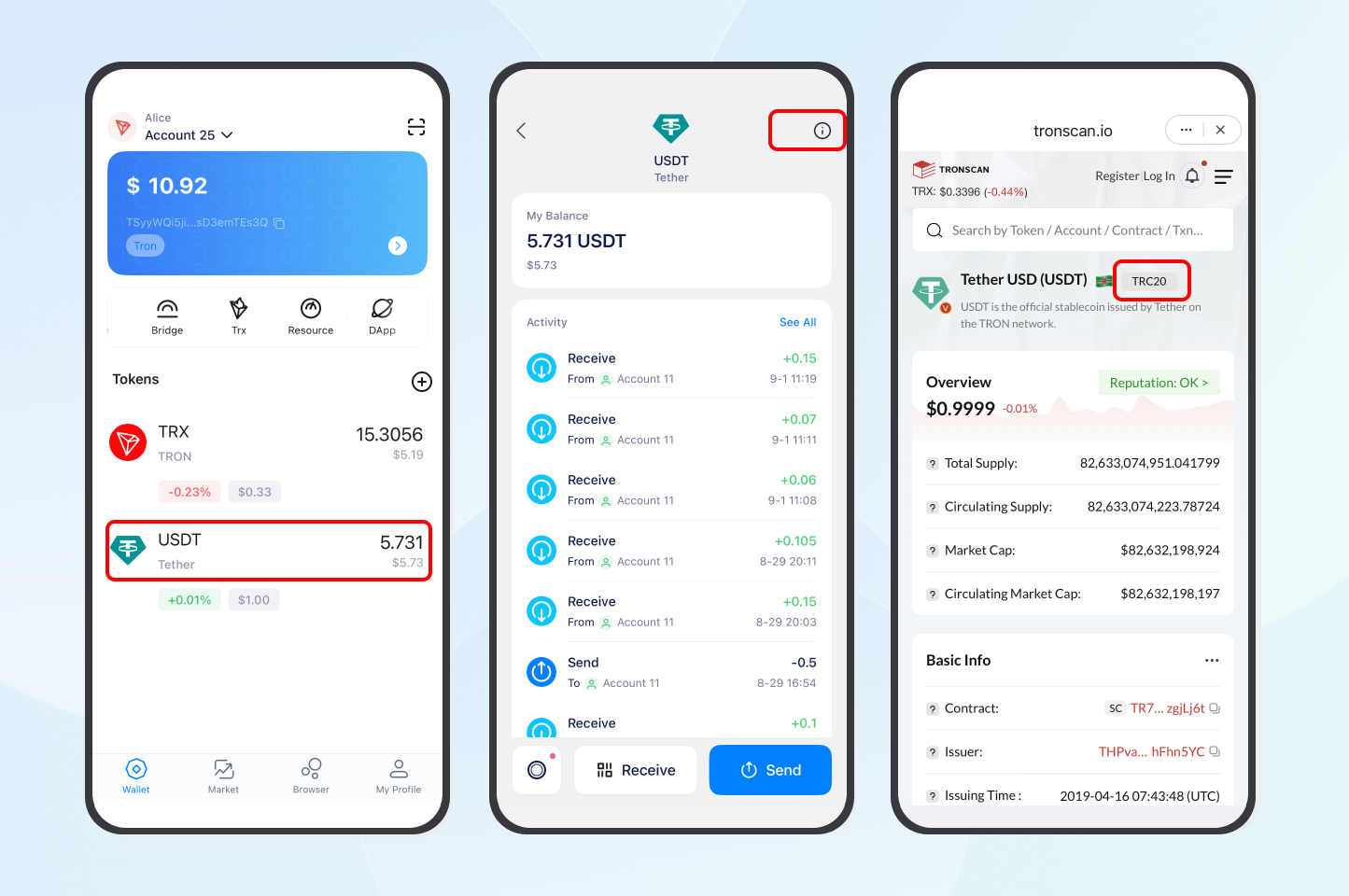
USDT-TRC20 is simply Tether’s stablecoin issued on TRON rather than on Ethereum. Because TRON’s fee model is cheap for routine transfers, this standard has become one of the most widely used rails for moving USDT between people, exchanges, and merchants. You can confirm any transaction on a public explorer such as TronScan.
How Do TRC20 Transactions Actually Work?
TRC20 tokens run through smart contracts on TRON’s network. Two resources power each transfer: energy (for smart-contract execution) and bandwidth (for the transaction’s data footprint). You can obtain these resources in two ways:
- Stake TRX: Freezing TRX gives you a daily allowance of energy and bandwidth at no per-transfer cost.
- Burn TRX: If you lack staked resources, the network deducts TRX to cover the transfer.
This is why a single “fee” figure for a USDT transfer is misleading. Sending to an address that has never held tokens (an unactivated account) costs more because the contract must allocate storage. Sending to an active address costs less. Rather than relying on a fixed number, check live costs on TronScan or compare energy pricing through services like TRON energy and fee tools before you send.
TRC20 vs ERC20: Which Is Better for USDT?
USDT exists on several chains. The two most common are TRC20 (TRON) and ERC20 (Ethereum). Each has clear trade-offs rather than one being universally “better.”
| Feature | TRC20 (TRON) | ERC20 (Ethereum) |
| Speed | Seconds | Usually under a few minutes |
| Typical fee | Variable; often low, sometimes a few dollars | Variable; commonly higher during congestion |
| Decentralization | DPoS, fewer validators (more concentrated) | Larger, more distributed validator set |
| Ecosystem | Strong for payments and stablecoin transfers | Broadest DeFi and dApp ecosystem |
For frequent, smaller USDT transfers, TRC20 is often more economical. For deep DeFi activity or maximum decentralization, ERC20 on Ethereum still leads. Many users hold USDT on both, choosing the network that fits each transaction.
How Do You Transfer USDT With TRC20 Safely?
Moving USDT on TRC20 is straightforward once your wallet is set up. The steps below apply to most non-custodial wallets:
- Choose a wallet: TronLink (software) or a Ledger device (hardware) are common, reputable options.
- Set up and back up: Create the wallet and store your recovery phrase offline. Never share it.
- Add a little TRX: Keep a small TRX balance, or stake TRX, to cover energy and bandwidth.
- Confirm the network: Make sure you select the TRC20 (TRON) network, not ERC20, on both sending and receiving sides.
- Verify the address: TRC20 addresses begin with “T.” Copy and paste, then double-check the first and last characters.
- Send and confirm: Submit the transfer and verify it on TronScan.
Sending USDT to an ERC20 address using the TRC20 network (or vice versa) can result in permanent loss of funds. The network choice is the single most important detail to get right.
Is TRC20 Safe for Storing and Sending USDT?
The TRC20 standard and TRON’s blockchain are mature and widely used, and every transfer is recorded immutably on a public ledger. That said, the protocol’s safety does not protect you from human error or scams. Most losses come from user mistakes, not from the network itself. Reduce your risk with these habits:
- Use trusted wallets: Prefer well-reviewed software wallets or a hardware wallet for larger balances.
- Verify every address: Confirm it starts with “T” and matches the recipient exactly.
- Enable extra security: Use device passcodes, two-factor authentication on exchanges, and a strong wallet password.
- Avoid phishing: Ignore “free USDT” offers and unsolicited links. Only use official wallet and exchange sites.
- Keep keys offline: Store your recovery phrase on paper or metal, never in cloud notes or photos.
What Can You Do With TRC20 in DeFi?
USDT on this standard is widely used across TRON’s decentralized finance ecosystem, including lending platforms like JustLend and decentralized exchanges like SunSwap. Common activities include:
- Lending and staking: Supplying USDT to a lending market can earn a variable yield.
- Providing liquidity: Adding tokens to a pool on SunSwap can earn fees, but exposes you to impermanent loss.
- Payments and gaming: Tokens such as BitTorrent Token (BTT) power file-sharing and other dApps.
Important risk note: DeFi is not low-risk. Smart-contract bugs, stablecoin de-pegs, and market swings can cause partial or total loss of principal. Advertised yields are variable and never guaranteed. Staking TRX directly with TRON’s network is a separate, generally simpler option, and platforms differ widely in risk. None of this is financial advice; do your own research and consider a licensed advisor. For background on resource staking, see TRON’s official resource model documentation and our overview of how TRON network fees affect USDT transfer costs.
Best Wallets for USDT on TRON Compared
Wallet choice depends on how much you hold and how often you transact. The comparison below summarizes widely used options. Ratings reflect general user sentiment and should be verified on current app stores.
| Wallet | Type | Best for | DeFi support |
| TronLink | Software | Everyday TRC20 transfers | JustLend, SunSwap |
| Ledger | Hardware | Long-term, larger holdings | Limited |
| Trust Wallet | Software | Multi-chain users | Partial |
| Gem Wallet | Software (open-source) | Privacy-minded users | SunSwap |
For day-to-day use, a software wallet like TronLink is convenient. For savings you rarely touch, a hardware wallet adds cold-storage protection.
Frequently Asked Questions About TRC20
What is the difference between TRC20 and USDT? USDT is the stablecoin; TRC20 is the network standard it can be issued on. USDT-TRC20 means Tether on the TRON network, as opposed to USDT-ERC20 on Ethereum.
How much does a USDT transfer cost on this network? There is no fixed fee. It depends on whether the recipient’s account is active and whether you have staked TRX for energy. Costs can range from near-free to a few dollars. Always check current rates on a live source like TronScan.
Can I send USDT to an ERC20 wallet from TRON? No. The networks are not interchangeable. Sending across mismatched networks can permanently lose your funds. Always confirm both sides use the same standard.
Is USDT on TRON safe? The network is mature and transparent, but most losses stem from scams and user error. Verify addresses, use trusted wallets, and protect your recovery phrase.
Do I need TRX to send these tokens? Yes, in effect. You need either staked TRX (for free energy and bandwidth) or a small TRX balance to burn for fees.
Is TRON more centralized than Ethereum? TRON’s DPoS model relies on a smaller set of elected validators, which is generally considered more centralized than Ethereum’s larger validator set. This is a trade-off for its speed and low cost.
⚠️ Not financial advice. This article is for educational and informational purposes only and reflects the author’s opinion at the time of writing. It is not investment, financial, legal, or tax advice. Cryptocurrency is highly volatile and you can lose your entire principal; prices, APYs, and on-chain fees change constantly and may be out of date. Always do your own research (DYOR) and consult a licensed financial advisor before buying, selling, staking, or lending any digital asset.
Disclosure: This is the official TronSave blog. TronSave sells TRON energy/resource (fee-reduction) services and has a commercial interest in the products and topics covered here.