To buy Tron energy with API, install TronWeb, generate an API key from an energy marketplace such as TronSave, then call an estimate endpoint and submit a signed TRX transaction to place an order. Automating this lets a wallet or dApp top up energy programmatically and cut USDT TRC-20 transfer fees.
Key Takeaways
- You can buy Tron energy with API programmatically so smart-contract calls like USDT transfers cost far less TRX than burning resources on the fly.
- A standard USDT TRC-20 transfer needs roughly 64,285–65,000 energy units (verify on TronScan, as the figure changes with contract updates).
- Energy can also be obtained by staking (freezing) TRX yourself; renting via API suits short-term or bursty demand, while staking suits steady long-term usage.
- Compare providers on price per unit, API reliability, documentation, and testnet support before committing.
- Estimates here are educational only; TRX price, fees, and yields vary and are not guaranteed.
What Is Tron Energy and Why Does It Matter?
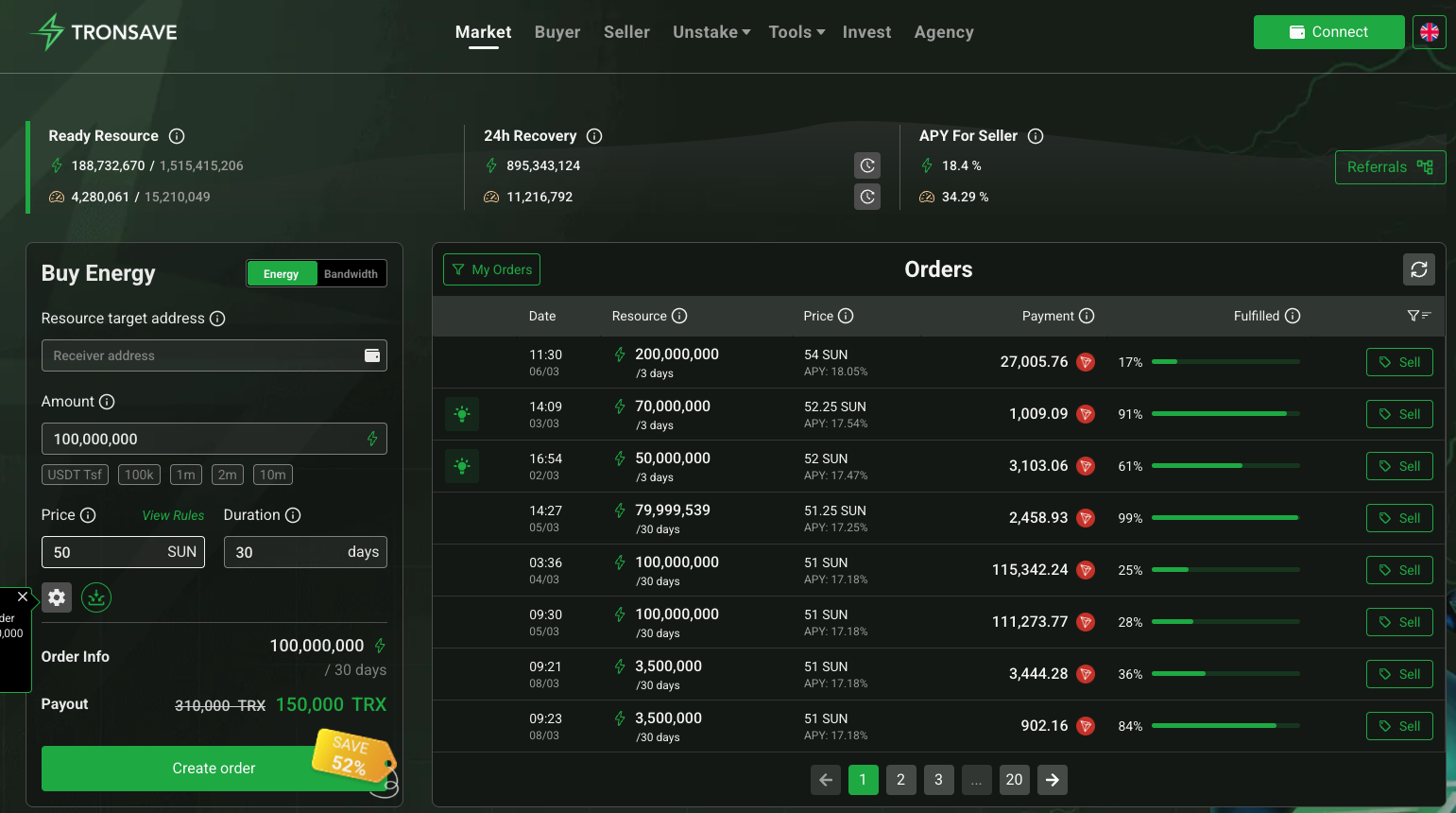
Tron has two resources: bandwidth and energy. Bandwidth covers simple TRX transfers, and every account gets a small free daily allowance. Energy powers smart-contract execution, including USDT (TRC-20) transfers and DeFi interactions.
If your account lacks energy, the network burns TRX to cover the cost, which can be expensive at scale. As of 2026 a single USDT transfer consumes roughly 64,285 energy; without energy that can mean burning several TRX per transfer (the exact TRX amount depends on the live TRX price and current network parameters, so verify against a primary source before budgeting).
Acquiring energy ahead of time, rather than burning TRX, is what makes automation worthwhile. For background, see our explainer on what Tron energy is and the deeper Tron energy and bandwidth guide.
How Do You Get Energy: Rent or Stake?
- Stake (freeze) TRX: Lock your own TRX under Stake 2.0 to receive energy continuously. Best for steady, predictable workloads. See how to stake TRON.
- Rent via marketplace API: Buy short-duration energy on demand from platforms like TronSave, TRONSCAN’s resource tools, or other energy markets. Best for bursts, batch jobs, or dApps that pay fees for users.
- Burn TRX: The default fallback when you hold no energy. Simplest, but usually the most expensive per transfer.
How Do You Buy Tron Energy With API Step by Step?
The workflow is the same across most marketplaces: estimate the cost, sign a TRX payment transaction with your private key, then submit the order. Below is a setup using TronWeb and the TronSave API as one concrete example; other providers expose similar REST endpoints.
Step 1: Install Node.js and TronWeb
- Install Node.js (v16+) from the official site and confirm with
node -v. - Add TronWeb to your project:
npm install tronweb. - Verify the install with
npm list tronweb.
Step 2: Secure Your Keys
- Generate an API key from your provider’s developer portal.
- Never hard-code secrets. Store them in environment variables: add
PRIVATE_KEYandAPI_KEYto a.envfile and load them withnpm install dotenv. - Keep
.envout of version control and rotate keys if they are ever exposed.
Step 3: Estimate, Sign, and Submit the Order
The script below estimates the TRX cost, builds a signed payment, and creates the order. Note that current TronWeb no longer requires the deprecated eventServer parameter.
const TronWeb = require('tronweb')
const TRONSAVE_RECEIVER_ADDRESS = "TWZEhq5JuUVvGtutNgnRBATbF8BnHGyn4S" // testnet: "TATT1UzHRikft98bRFqApFTsaSw73ycfoS"
const PRIVATE_KEY = process.env.PRIVATE_KEY
const TRON_FULLNODE = "https://api.trongrid.io" // testnet: "https://api.nileex.io"
const TRONSAVE_API_URL = "https://api.tronsave.io" // testnet: "https://api-dev.tronsave.io"
const REQUEST_ADDRESS = "your_request_address"
const TARGET_ADDRESS = "your_target_address"
const BUY_AMOUNT = 100000
const DURATION = 3 * 86400 * 1000 // 3 days
const tronWeb = new TronWeb({ fullNode: TRON_FULLNODE, solidityNode: TRON_FULLNODE, privateKey: PRIVATE_KEY })
const GetEstimate = async (request_address, target_address, amount, duration) => {
const url = TRONSAVE_API_URL + "/v0/estimate-trx"
const body = { amount, buy_energy_type: "MEDIUM", duration_millisec: duration, request_address, target_address: target_address || request_address, is_partial: true }
const data = await fetch(url, { method: "POST", headers: { "content-type": "application/json" }, body: JSON.stringify(body) })
return await data.json()
}
const GetSignedTransaction = async (estimate_trx, request_address) => {
const tx = await tronWeb.transactionBuilder.sendTrx(TRONSAVE_RECEIVER_ADDRESS, estimate_trx, request_address)
return await tronWeb.trx.sign(tx, PRIVATE_KEY)
}
const CreateOrder = async (signed_tx, target_address, unit_price, duration) => {
const url = TRONSAVE_API_URL + "/v0/buy-energy"
const body = { resource_type: "ENERGY", unit_price, allow_partial_fill: true, target_address, duration_millisec: duration, tx_id: signed_tx.txID, signed_tx }
const data = await fetch(url, { method: "POST", headers: { "content-type": "application/json" }, body: JSON.stringify(body) })
return await data.text()
}
const BuyEnergy = async () => {
const est = await GetEstimate(REQUEST_ADDRESS, TARGET_ADDRESS, BUY_AMOUNT, DURATION)
const { unit_price, estimate_trx, available_energy } = est
if (available_energy >= BUY_AMOUNT) {
const signed = await GetSignedTransaction(estimate_trx, REQUEST_ADDRESS)
console.log(await CreateOrder(signed, TARGET_ADDRESS, unit_price, DURATION))
}
}
BuyEnergy()
Step 4: Audit Energy With the Resource API
To confirm an account’s available energy, read on-chain resources with the proper resource API rather than a non-existent account.energy field:
const res = await tronWeb.trx.getAccountResources(tronWeb.defaultAddress.base58)
const energy = (res.EnergyLimit || 0) - (res.EnergyUsed || 0)
console.log('Available energy:', energy)
You can cross-check the same account and any order transaction hash on TronScan, and confirm endpoint behavior in the official TRON developer documentation.
How Do You Pick a Tron Energy Provider?
Provider choice affects both cost and uptime. Evaluate at least two so a single outage does not stall your dApp, and add failover logic. The comparison below reflects publicly listed self-reported figures and should be re-verified on each provider’s site before you rely on it.
| Factor | What to check | Why it matters |
| Price per unit | Listed TRX/energy and any minimums | Drives your per-transfer savings |
| API reliability | Documented uptime, status page | Downtime can block user transactions |
| Documentation | Clear REST/SDK references, examples | Faster, safer integration |
| Testnet support | Nile/Shasta endpoints | Test without burning real TRX |
TronSave, Tron Energy Market, and TRONSCAN’s resource tools are common starting points. Prices and feature sets change, so treat any single quote as a snapshot and verify it live.
How Much Can Automation Save on TRC-20 Fees?
Savings depend entirely on the live TRX price, the provider’s unit price, and how many transfers you make. The mechanism is simple: renting or staking for energy is typically cheaper per transfer than burning TRX outright, especially at volume.
- Low volume: Burning TRX may be acceptable; automation overhead may not pay off.
- High volume or dApps: Buying energy in batches via API usually reduces cost per USDT transfer significantly (estimate your own numbers with a current TRX price; do not treat any fixed dollar figure as guaranteed).
For deeper cost context, see how to send USDT on Tron and how much TRX is needed to send USDT. Run your own estimate via the marketplace’s estimate-trx endpoint before budgeting.
How Do You Keep an Energy Automation Setup Secure?
- Protect keys: Store private keys in a secrets manager (for example AWS KMS) or encrypted environment variables, never in source code.
- Rate limit: Most APIs cap requests (often around 100/hour); add retry-with-backoff and a client-side limiter such as
rate-limiter-flexible. - Audit on-chain: Verify each order and resource change on TronScan using the transaction hash.
- Test first: Run the full flow on the Nile testnet before going to mainnet.
Frequently Asked Questions
What does it mean to buy Tron energy with API? It means calling a marketplace’s REST endpoints to rent energy programmatically, paying in TRX, so your wallet or dApp can top up energy automatically instead of burning TRX per transaction.
How much energy does a USDT TRC-20 transfer need? Roughly 64,285 energy as of 2026, though the exact figure changes with contract updates. Always verify the current value on TronScan before sizing orders.
Is renting energy cheaper than staking TRX? It depends on usage. Renting suits short-term or bursty demand; staking suits steady, long-term needs. Neither outcome is guaranteed, and APRs and unit prices fluctuate.
Why is my transaction still failing after buying energy? Common causes are insufficient TRX for bandwidth, an order that only partially filled, or a wrong target address. Check the account balance and resources, then confirm the order on TronScan.
Can I test before spending real TRX? Yes. Use the Nile testnet endpoints and testnet receiver address to validate your integration without spending mainnet TRX.
Which providers can I use? TronSave, Tron Energy Market, and TRONSCAN’s resource tools are common options. Compare price, uptime, docs, and testnet support, and consider running more than one for redundancy.
⚠️ Not financial advice. This article is for educational and informational purposes only and reflects the author’s opinion at the time of writing. It is not investment, financial, legal, or tax advice. Cryptocurrency is highly volatile and you can lose your entire principal; prices, APYs, and on-chain fees change constantly and may be out of date. Always do your own research (DYOR) and consult a licensed financial advisor before buying, selling, staking, or lending any digital asset.
Disclosure: This is the official TronSave blog. TronSave sells TRON energy/resource (fee-reduction) services and has a commercial interest in the products and topics covered here.