Key takeaways
- A standard USDT TRC20 transfer costs roughly $2.08–$4.16 (estimate; verify with a live tracker).
- First-time transfers to empty wallets cost more (~130,000 energy) than repeat transfers (~65,000 energy).
- Fees are paid in TRX, so the USD cost moves with the TRX price.
- Energy rental or staking TRX can cut your transfer fee significantly versus burning TRX directly.
- All USD figures here are snapshots — always confirm on TronScan before sending.
How much does it cost to send USDT TRC20 in 2026?
On the Tron network, every USDT transfer consumes energy (for the smart-contract execution) and a small amount of bandwidth. If you do not have staked resources, the network burns TRX to cover them, and that burned TRX is your fee. Here is a typical breakdown as of early 2026 (verify against a primary source, since the TRX price changes constantly):- First transfer to an empty wallet: ~130,000 energy, roughly 13 TRX, about $4.16 at ~$0.32/TRX.
- Transfer to an active wallet: ~65,000 energy, roughly 6.5 TRX, about $2.08.
- With energy rental: often lower, because you pay for pre-staked energy instead of burning TRX at the full network rate.
What factors change the cost to send USDT TRC20?
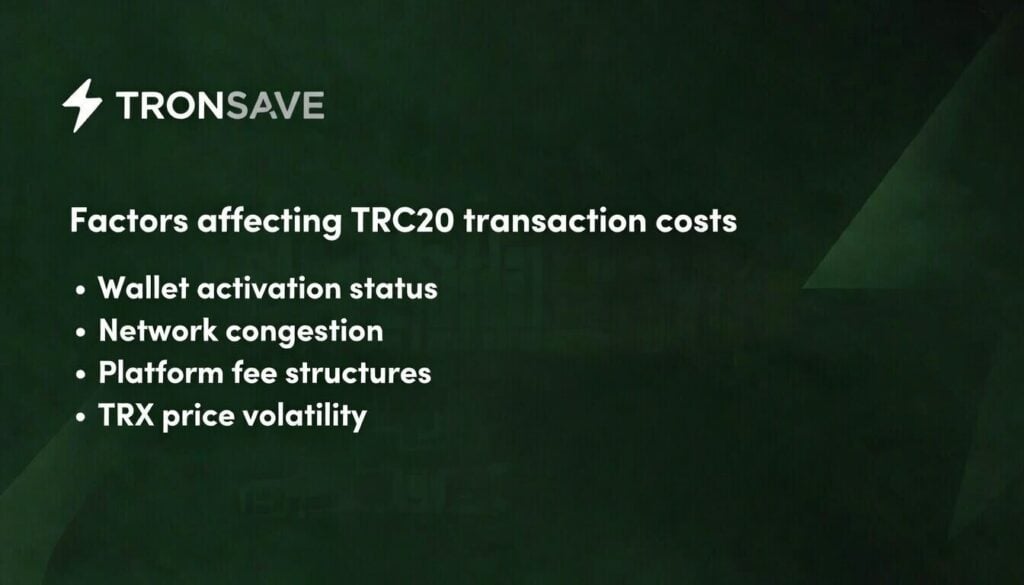
The fee is not fixed. Several variables push your transfer cost up or down on any given day.Wallet activation status
Empty recipient wallets need ~130,000 energy; wallets that already hold at least a little USDT need only ~65,000. Checking the recipient on TronScan before sending helps you avoid the higher activation fee.TRX price volatility
Because fees are denominated in TRX, the USD cost rises and falls with the market. At roughly $0.32/TRX (snapshot, July 2026; verify live), 13 TRX is about $4.16 and 6.5 TRX is about $2.08. You can monitor the live price on CoinMarketCap.Network conditions
During heavy DeFi or NFT activity, energy demand rises and the effective cost can edge toward the upper end of the range. Tron generally stays more stable than Ethereum, but timing transfers during quieter hours can still trim a little off the cost.How you pay for resources
You can burn TRX automatically, stake TRX to generate free daily energy, or rent energy. Each path changes the final fee, as the table below shows. If you hold TRX long-term, you can also flip the equation: sell your surplus energy on TronSave Earn and collect APY instead of paying fees.| Scenario | Energy used | Estimated cost (USD)* |
| First transfer (empty wallet, burn TRX) | ~130,000 | ~$4.16 |
| Repeat transfer (active wallet, burn TRX) | ~65,000 | ~$2.08 |
| Repeat transfer with energy rental | ~65,000 (rented) | Often lower than burning |
| Staked TRX (own energy) | From staked balance | ~$0 marginal |
How does TRC20 compare to ERC20 and BEP20?
Tron’s USDT TRC20 fees are among the lowest for stablecoin transfers, but a fair comparison depends on live gas prices. Ethereum (ERC20) fees swing widely with network demand.- ERC20 (Ethereum): a USDT transfer commonly costs anywhere from ~$1 to $10+ depending on gas — check a live gas tracker such as Etherscan’s gas tracker for current rates.
- BEP20 (BNB Chain): usually inexpensive, often well under $1, though throughput and ecosystem differ.
- TRC20 (Tron): typically $2.08–$4.16 by direct burn, with fast finality and predictable resource costs.
| Network | Typical USDT fee (USD) | Best for |
| TRC20 (Tron) | ~$2.08–$4.16 | Frequent stablecoin transfers |
| ERC20 (Ethereum) | ~$1–$10+ (gas-dependent) | Deep DeFi liquidity |
| BEP20 (BNB Chain) | Often under $1 | Budget alternative |
How can you reduce your USDT transfer fee?
A few simple habits keep your fees low. None of these are exclusive to one provider — pick what fits how often you transact.- Send to active wallets: avoid the higher activation energy by transacting with wallets that already hold USDT.
- Stake TRX for energy: long-term holders can stake TRX to generate daily energy and effectively send for near-zero marginal cost. See the official TRON resource model docs for how staking, energy, and bandwidth work.
- Rent energy: services such as TronSave and other Tron energy marketplaces let you pay for pre-staked energy, which is often cheaper than burning TRX. Compare a few before committing.
- Time your transfers: sending during quieter network hours can shave a little off the cost.
- Compare exchange withdrawal fees: platforms like Binance or OKX add their own flat fees, which may exceed the on-chain cost for small amounts.
FAQ: Frequently asked questions
How much does a first-time USDT TRC20 transfer cost? Roughly 13 TRX (about $4.16 at ~$0.32/TRX), because an empty wallet needs ~130,000 energy to activate. Verify the live figure on TronScan. What does a repeat transfer cost? About 6.5 TRX (around $2.08) when sending to a wallet that already holds USDT, since it uses roughly half the energy. Why does the cost to send USDT TRC20 change day to day? Fees are paid in TRX, so the USD value rises and falls with the TRX market price and with network energy demand. Can I send USDT TRC20 for free? Effectively yes, if you stake enough TRX to generate the energy a transfer needs; you then pay no extra TRX burn, only your staked capital is locked. Is TRC20 cheaper than ERC20? Usually, but not always. ERC20 fees depend on Ethereum gas and can range from ~$1 to $10+. Check a live gas tracker to compare for your moment. Where can I verify the current fee? Look up a recent USDT transfer on TronScan to see the exact energy, bandwidth, and TRX consumed, and check the TRX price on CoinMarketCap.⚠️ Not financial advice. This article is for educational and informational purposes only and reflects the author’s opinion at the time of writing. It is not investment, financial, legal, or tax advice. Cryptocurrency is highly volatile and you can lose your entire principal; prices, APYs, and on-chain fees change constantly and may be out of date. Always do your own research (DYOR) and consult a licensed financial advisor before buying, selling, staking, or lending any digital asset.
💡 Pay less right now: instead of burning TRX, rent TRON energy on the TronSave market and cut your USDT (TRC20) transfer cost by 60–80% — energy arrives in seconds.
💡 2026 update: Since TRON’s Proposal #104 (Aug 29, 2025) cut the energy unit price from 210 to 100 sun (~60%), the average USDT (TRC‑20) transfer fee fell from about $2.47 to ~$0.72 (network-wide average; a typical burn-paid transfer still runs ~$2–$4 — full breakdown below). Rent energy on the TronSave market to pay even less — often under $1.
👉 Try it free: use the USDT Fee Savings Calculator to see exactly how much you’d save by renting TRON energy instead of burning TRX.
Disclosure: This is the official TronSave blog. TronSave sells TRON energy/resource (fee-reduction) services and has a commercial interest in the products and topics covered here.
Sending at scale? Learn how to buy TRON energy in bulk for high-volume USDT, or auto-top-up with Auto-Buy.